TBA-001 · Public Evidence Audit
Jane Maria Clouson
Kidbrooke Lane, Eltham · April 1871
This case is commonly retold as a straightforward miscarriage of justice: a guilty man freed by class privilege. The surviving record supports a more precise and more useful conclusion — one that separates what is factually established from what remains contested, and identifies exactly where the popular narrative outruns the evidence.
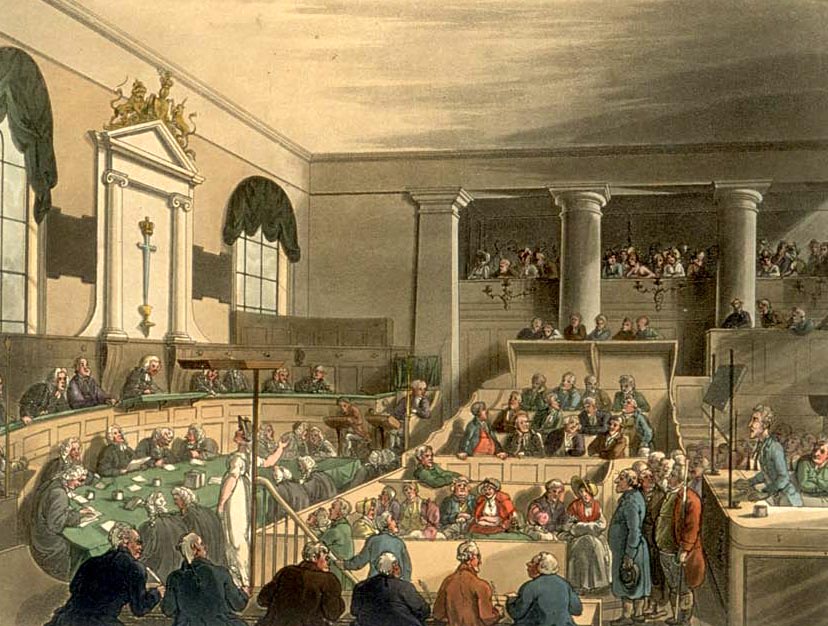
The Old Bailey courtroom, engraving by Thomas Rowlandson and Augustus Pugin, from Ackermann’s Microcosm of London, 1808. No contemporary image of Jane Clouson survives; this depicts the court where the case against Edmund Pook was heard.
Claim tested
What does the surviving record establish about Jane Clouson’s death, and about the case against the man tried for her murder?
Concise verdict
The assault and death are established beyond doubt. The identity of the assailant is not. The case against the accused, Edmund Walter Pook, was built entirely on circumstantial evidence, and he was formally acquitted after the trial judge ruled Clouson’s dying statement inadmissible. No one was ever convicted.
Why this claim matters
The Clouson case is frequently used as an illustration of Victorian class injustice — a servant girl’s death, a wealthy family’s son acquitted. That framing is defensible as public memory, but it is not what the trial record itself establishes. Retelling it as settled fact about motive and guilt goes beyond the evidence; retelling it as an unresolved case with a specific, identifiable evidentiary failure (an inadmissible dying declaration) is both more accurate and, if anything, a sharper story.
Chronology
LATE APRIL 1871
Jane Clouson, a domestic servant employed by the Pook family of Greenwich, is found badly beaten in Kidbrooke Lane, Eltham, by a police constable on patrol. A bloodstained hammer is found near the scene. Her purse, containing 11 shillings and 4 pence, is untouched; there is no evidence of sexual assault. (Sources differ on whether this was 25 or 26 April — see Contradiction Table.)
FOLLOWING DAYS
Clouson is taken to hospital, unidentified. She is reported to have said “Oh, let me die,” and, before losing consciousness, to have named “Edmund Pook” as her attacker. She dies of her injuries on 30 April 1871. (Sources differ on whether this was four or five days after the assault.)
1 MAY 1871
Clouson is identified by relatives. Edmund Walter Pook, a printer and the son of her former employer, is arrested the same day.
CORONER’S INQUEST
An inquest returns a verdict of wilful murder against Pook, based on circumstantial evidence: a man matching his description reportedly seen running from the scene; a hammer allegedly sold to him by a local shopkeeper days earlier; blood found on his clothing; and several witnesses who claimed to have seen Clouson and Pook together that evening.
10 JULY 1871
Full trial opens at the Central Criminal Court (Old Bailey). Pook is defended by John Walter Huddleston QC.
15 JULY 1871
The presiding judge rules that Clouson’s dying statement naming Pook is inadmissible hearsay, since it could not be tested by cross-examination. The jury acquits Pook after roughly twenty minutes’ deliberation. Contemporary opinion widely attributes the acquittal to Pook’s family’s social standing.
Source hierarchy
The trial record itself (testimony, the judge’s ruling on admissibility, the verdict) sits above secondary retellings. Contemporary press coverage of the July 1871 trial is a primary layer not independently re-examined for this audit. Modern narrative histories — chiefly Paul Thomas Murphy’s Pretty Jane and the Viper of Kidbrooke Lane (2017) — synthesise these primary layers and are treated here as secondary, informed sources, not as primary evidence in themselves.
Provenance assessment
Clouson’s alleged dying words are reported consistently across multiple secondary accounts, suggesting a stable transmission from the original testimony — but their evidential weight is a separate question from whether they were accurately reported. The judge’s specific ruling (hearsay, no cross-examination possible) is well-attested and is the load-bearing legal fact of the whole case.
Contradiction table
A dossier does not smooth over conflicts in the record. Where sources disagree, the disagreement is stated, not resolved by preference for the more commonly repeated version.
| Point of fact | Version A | Version B | Status |
|---|---|---|---|
| Date Clouson was found | 26 April 1871 | 25 April 1871 | Contradicted |
| Days between assault and death | Four days | Five days | Contradicted |
| Clouson’s age at death | 16 | 17 (per cemetery memorial inscription) | Contradicted |
A fully resourced investigation would resolve these discrepancies against the coroner’s register, hospital admission records, and contemporary press reporting filed at the time. This audit has not undertaken that primary-archive verification (see Unresolved Evidence Gaps).
Evidential classification
| Claim | Classification |
|---|---|
| Clouson was fatally assaulted in Kidbrooke Lane in April 1871 | Supported |
| Clouson was reported to have named Pook before she died | Probable (as to the report itself) |
| That dying statement is reliable evidence against Pook | Unsupported (ruled inadmissible hearsay) |
| Edmund Pook committed the assault | Disputed (acquitted; case entirely circumstantial) |
| The acquittal resulted from Pook’s social class rather than the evidence | Unsupported as historical fact |
What can safely be said
“Jane Clouson was murdered in Eltham in 1871; the man tried for her killing, Edmund Pook, was acquitted after the trial judge ruled her dying statement inadmissible. No one was ever convicted.” This is directly supportable from the trial record and avoids asserting guilt or innocence beyond what the evidence establishes.
Unresolved evidence gaps
The exact discovery date, days-to-death interval, and Clouson’s precise age remain unresolved pending primary-archive verification (coroner’s register, hospital records, contemporary press). This audit has not undertaken that verification and states the gap explicitly rather than silently adopting one version.
Source schedule
| Source | Type |
|---|---|
| Murphy, P.T., Pretty Jane and the Viper of Kidbrooke Lane (Pegasus, 2017) | Secondary — narrative history |
| Higgs, E., “Domestic Servants and Households in Victorian England,” Social History, Vol. 8, No. 2 (1983) | Secondary — academic |
| Farrah, F., The Eltham Tragedy Reviewed (1871) | Contemporary pamphlet |
Commission work using this method.
Private dossiers apply the same source hierarchy, provenance assessment, contradiction mapping and evidential classification to your subject — scoped to your specific claim, intended use and deadline.