TBA-002 · Public Evidence Audit
Julia Martha Thomas
Richmond, Surrey · March 1879
This case is commonly retold as a straightforward story of calculated Victorian savagery: a maid murders her employer, dismembers the body, and tries to sell the rendered fat to the neighbours as dripping. The surviving record supports the murder and the dismemberment without qualification. The fat story does not hold up, and the “calculated” framing sits awkwardly against the killer’s own account of how the killing began.
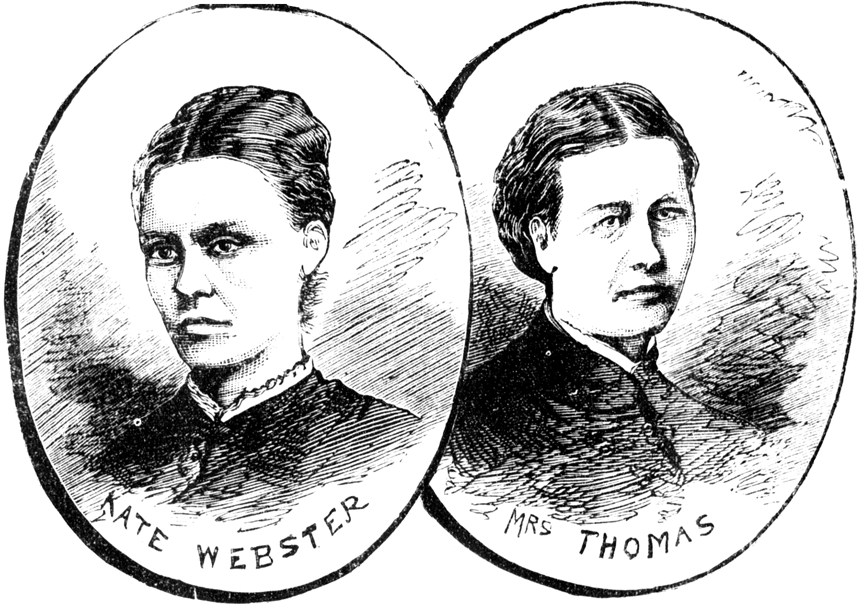
Kate Webster (left) and Julia Martha Thomas (right), contemporary print from the Illustrated Police News, 12 July 1879.
Claim tested
What does the surviving record establish about the killing of Julia Martha Thomas, the identity of the 2010 skull, and the “sold as dripping” story that dominates modern retellings?
Concise verdict
Kate Webster’s guilt, confession and execution are not in doubt. The 2010 skull’s identification as Thomas rests on strong circumstantial and forensic indicators, not DNA; no relatives could be traced and the original burial location was unrecorded, so the 2011 coroner’s conclusion is properly read as “convincing,” not conclusive. The widely repeated claim that Webster sold rendered fat to neighbours as dripping was never put in evidence at trial and is treated by the two academic studies that examined it as probable legend.
Why this claim matters
The “dripping” detail is the single most-repeated image in popular retellings of this case, because it is the most grotesque. It is also the detail least supported by the record: it was never offered as evidence at the Old Bailey, several incompatible versions of the story circulate, and two independent mid-20th-century studies of the case both concluded it is more likely apocryphal than true. Separately, the case is often framed as a premeditated murder for gain, yet Webster’s own confession, uncontradicted on this point, describes a quarrel that escalated into violence, followed by a panicked disposal of the body, not a planned killing. Both corrections make the case less cinematic and more precisely what the record shows.
Chronology
29 JANUARY 1879
Julia Martha Thomas, a widowed former schoolteacher in her mid-50s living alone at 2 Mayfield (Vine) Cottages, Park Road, Richmond, engages Kate Webster as her domestic servant. The relationship deteriorates quickly; Thomas gives Webster notice, later extended by a few days at Webster’s request.
SUNDAY 2 MARCH 1879
Webster returns late from her half-day off, delaying Thomas for evening service. On Thomas’s return, the two women quarrel upstairs. By Webster’s own later account, she pushed Thomas down the stairs in anger, then choked her during the resulting struggle to stop her screaming. Webster then dismembers the body in the house, boiling portions in the laundry copper and burning smaller bones in the hearth.
3-17 MARCH 1879
Webster disposes of the remains in stages: the torso and legs are packed into a box thrown from Richmond Bridge; a foot is discarded separately in Twickenham; the head is buried under the stable yard of a nearby public house. She poses as “Mrs Thomas” for tradesmen and old acquaintances, and agrees to sell Thomas’s furniture to a publican, John Church.
5-11 MARCH 1879
A box containing a torso and legs is found in shallow water near Barnes Railway Bridge. A doctor’s examination cannot identify the remains, which are buried unidentified. The press names the unsolved case the “Barnes Mystery.”
18-29 MARCH 1879
The furniture removal exposes the impersonation; Webster flees to her family’s home near Enniscorthy, County Wexford, and is arrested there on 29 March.
2-8 JULY 1879
Six-day trial at the Old Bailey before Mr Justice Denman. Webster attempts to implicate Church and a former neighbour, Porter; both have solid alibis and are cleared. The jury convicts after roughly 75 minutes’ deliberation.
POST-VERDICT
Webster pleads pregnancy to avoid sentence. A jury of matrons, an archaic procedure, examines her and finds her not “quick with child.” An appeal to the Home Secretary is refused.
28-29 JULY 1879
The night before execution, Webster makes a full confession, taking sole responsibility and formally exonerating Church, Porter and a third man she had earlier implicated. She is hanged at Wandsworth Prison on 29 July.
OCTOBER 2010 TO JULY 2011
A skull is found during building work on the site of the former public house stables. Radiocarbon dating places it between 1650 and 1880; its position atop Victorian-era tiles, a fracture pattern consistent with a fall down stairs, and collagen loss consistent with boiling are all noted. In July 2011 a coroner rules the skull is Thomas’s and records a verdict of unlawful killing, superseding the 1879 open verdict. No DNA comparison was possible: Thomas died childless and no traceable relatives, nor a recorded burial plot for the rest of her remains, existed to compare against.
Source hierarchy
The Old Bailey trial record and Webster’s own confession statements sit as primary evidence for the killing itself. The 2011 coroner’s inquest is a primary official finding for the skull’s identity, but one explicitly built on circumstantial and forensic indicators rather than genetic proof. Two mid-20th-century studies of the case (Wilson, 1971; Gribble, 1957) are treated as informed secondary sources, used here specifically for their assessment of the “dripping” story rather than as trial evidence.
Provenance assessment
Webster’s confession was given the night before her execution, with no further legal jeopardy attached to it and with the effect of clearing three men she had previously accused, a context that weighs in favour of its reliability rather than against it. The “dripping” allegation, by contrast, has no comparable anchor: it surfaces in press and later popular retellings in materially different forms, and was not tested by cross-examination at trial.
Contradiction table
A dossier does not smooth over conflicts in the record. Where sources disagree, the disagreement is stated, not resolved by preference for the more commonly repeated version.
| Point of fact | Version A | Version B | Status |
|---|---|---|---|
| Webster’s age at trial | Indictment record: 29 | Most modern retellings: 30 | Contradicted |
| Fat sold to neighbours as dripping/lard | Widely repeated as fact in popular accounts | No evidence offered at trial; two independent studies judge it probable legend, noting several incompatible versions | Contradicted |
| Identity of the 2010 skull | Popular reporting: “DNA confirmed” identification | Coroner’s own finding: no DNA comparison possible; verdict rests on circumstantial and forensic indicators, described by the coroner as “convincing,” not certain | Contradicted |
The age discrepancy is minor and does not affect any substantive finding; it is recorded because the audit does not silently pick one figure over another. The other two points affect how the case is properly described in any commissioned or broadcast retelling.
Evidential classification
| Claim | Classification |
|---|---|
| Webster killed Thomas and dismembered the body | Supported (confessed; uncontradicted by any other evidence) |
| The 2010 skull is Thomas’s | Probable (strong circumstantial/forensic indicators; no DNA confirmation was possible) |
| The killing was premeditated for financial gain | Disputed (jury inferred premeditation from a witness’s account of unrelated remarks; Webster’s own confession describes an escalating quarrel, not a plan) |
| Webster sold rendered fat as dripping to neighbours | Unsupported (not put in evidence at trial; judged probable legend by the studies that examined it) |
| Church, Porter and Webster’s other accused associates were involved | Unsupported (solid alibis; formally exonerated in Webster’s final confession) |
What can safely be said
“Kate Webster murdered and dismembered her employer, Julia Martha Thomas, in Richmond in March 1879, and was hanged for the crime that July. A skull found on the site in 2010 was identified by a coroner in 2011 as Thomas’s, based on circumstantial and forensic evidence rather than DNA. The widely repeated claim that Webster sold rendered fat from the body as dripping was never presented as evidence at trial.” This is directly supportable from the trial record, the confession, and the 2011 inquest findings.
Unresolved evidence gaps
The original 1879 inquest depositions and full Old Bailey sessions paper have not been independently examined against the trial transcript used here; both are held in physical archive and would require direct consultation rather than remote research. The precise original source and first appearance of the “dripping” story has not been traced to a single origin point; this audit reports the academic assessment of it as probable legend, not a definitive debunking with a named originator.
Source schedule
| Source | Type |
|---|---|
| Old Bailey Proceedings Online, Trial of Catherine Webster (ref. t18790630-653) | Primary: digitised trial record |
| O’Donnell, E., The Trial of Kate Webster (Notable British Trials series, William Hodge & Co., 1925) | Primary: edited trial transcript with introduction |
| Wilson, P., Murderess: A Study of the Women Executed in Britain since 1843 (Michael Joseph, 1971) | Secondary: academic assessment (source of “probable legend” finding on the dripping claim) |
| Gribble, L.R., Famous Judges and Their Trials (J. Long, 1957) | Secondary: independent concurring assessment |
| BBC News and Daily Telegraph reporting of the 2011 coroner’s inquest verdict (5 July 2011) | Contemporary press: reporting of primary official finding |
Commission work using this method.
Private dossiers apply the same source hierarchy, provenance assessment, contradiction mapping and evidential classification to your subject, scoped to your specific claim, intended use and deadline.