TBA-007 · Public Evidence Audit
The Death of Amy Robsart
Cumnor Place, Oxfordshire · 8 September 1560
Amy Robsart, wife of Robert Dudley, was found dead at the foot of a short staircase, alone in the house, on a day she had sent her entire household to a nearby fair. A coroner’s jury ruled it misadventure. A hostile political pamphlet, written twenty-four years later, named a specific assassin acting on Dudley’s orders. This audit separates the inquest’s own findings from what that later pamphlet added.
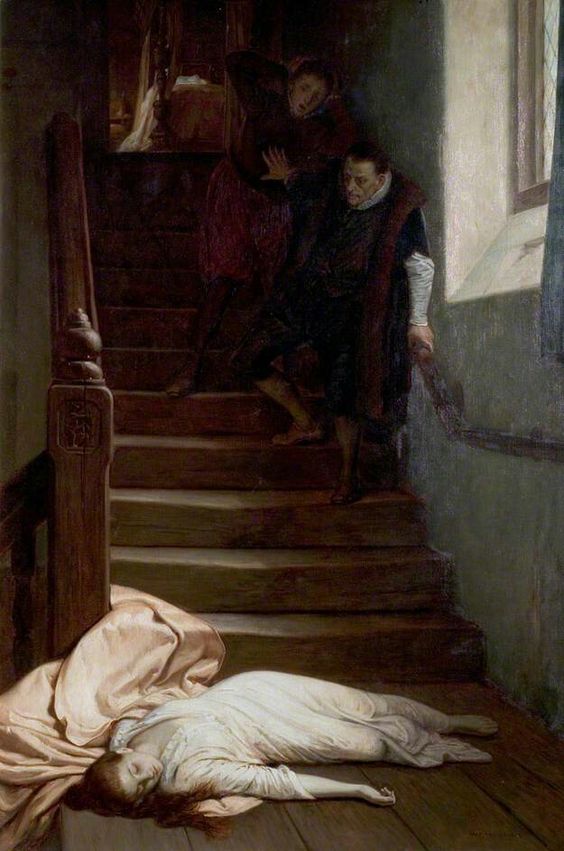
Amy Robsart, painting by William Frederick Yeames, 1877 (Tate) — a later imaginative depiction, not a contemporary portrait.
Claim tested
What does the coroner’s inquest establish about Amy Robsart’s death, and where does the specific murder narrative — Robert Dudley ordering the killing through his agent Richard Verney — actually originate?
Concise verdict
The inquest jury found a broken neck and two head wounds and returned a verdict of misadventure, recording no evidence of violence. The specific, named account of Dudley ordering Richard Verney to kill her comes from Leicester’s Commonwealth, a hostile Catholic political pamphlet published in 1584, twenty-four years after the death, with an explicit propagandistic purpose against Dudley. The inquest does not support that account. It also does not resolve why a short flight of stairs produced injuries several people close to the case, at the time and since, considered disproportionate.
Why this claim matters
This case is a clean demonstration of a distortion with a locatable point of origin. The murder narrative did not accumulate gradually through retelling; it was introduced, in named and specific form, by a single hostile pamphlet written a generation after the event for an openly political purpose. Distinguishing the inquest’s own verdict from Leicester’s Commonwealth’s additions is not a matter of interpretation. It is a matter of reading two different documents and being honest about which one says what.
Chronology
8 SEPTEMBER 1560
Amy Robsart, living at Cumnor Place, the residence of Sir Anthony Forster, sends her household to a fair at nearby Abingdon. She is found on their return at the bottom of a short flight of stairs, with a broken neck and two head wounds. Robert Dudley is at Windsor with the queen and is informed by messenger. His steward, Thomas Blount, is dispatched to Cumnor.
9 SEPTEMBER 1560
An inquest is opened at Cumnor before the coroner John Pudsey. Sources differ on whether the jury’s findings were finalised promptly or the inquest was adjourned and not formally concluded until nearly a year later; this audit has not yet resolved that discrepancy against the original record.
22 SEPTEMBER 1560
Amy Robsart is buried with considerable formal ceremony at the University Church of St Mary the Virgin, Oxford. Dudley does not attend the inquest or the funeral, a fact that fuelled contemporary suspicion regardless of its actual cause.
1584
Leicester’s Commonwealth is published, an anonymous and explicitly hostile Catholic political pamphlet attacking Dudley, by then Earl of Leicester. It names Richard Verney as the agent Dudley allegedly sent to Cumnor to kill Amy. This is the specific origin of the named-assassin version of the story still repeated today.
Source hierarchy
The coroner’s inquisition, quoted in translation across multiple modern accounts, sits as the primary record. Leicester’s Commonwealth (1584) is treated strictly as later, hostile, politically motivated construction, not as an independent witness account, regardless of how specific its detail. Modern academic assessments of the case are treated as secondary synthesis.
Provenance assessment
Sources consulted for this audit disagree on whether the original coroner’s inquisition document has survived intact or was reconstructed from later transcription; this audit treats the widely quoted inquisition text as provisionally reliable pending direct verification of its manuscript provenance, and flags this as unresolved rather than asserting either position with confidence. Leicester’s Commonwealth’s authorship remains anonymous and its hostile purpose is not disputed by any historian consulted for this audit.
Contradiction table
A dossier does not smooth over conflicts in the record. Where sources disagree, the disagreement is stated, not resolved by preference for the more commonly repeated version.
| Point of fact | Coroner’s inquest | Leicester’s Commonwealth (1584) | Status |
|---|---|---|---|
| Cause of death | Misadventure; accidental fall; no evidence of violence recorded | Deliberate murder, ordered by Dudley | Contradicted |
| Identity of any assassin | Not addressed; no third party implicated | Richard Verney named specifically | Sourced only to hostile pamphlet |
Evidential classification
| Claim | Classification |
|---|---|
| Amy Robsart died from a fall down a staircase at Cumnor Place on 8 September 1560 | Supported |
| The coroner’s jury returned a verdict of misadventure, finding no evidence of violence | Supported |
| Dudley ordered Richard Verney to kill her | Unsupported (sourced only to a hostile pamphlet written 24 years later) |
| The injuries were inconsistent with a fall down the specific staircase involved | Unresolved (a recurring lay observation, not addressed or resolved by the inquest record itself) |
What can safely be said
“Amy Robsart died from a fall at Cumnor Place on 8 September 1560. A coroner’s jury returned a verdict of misadventure and recorded no evidence of violence. The specific account naming Richard Verney as an assassin sent by Robert Dudley comes from a hostile political pamphlet, Leicester’s Commonwealth, published twenty-four years after her death.” This is directly supportable from the inquest findings as reported and the 1584 pamphlet itself.
Unresolved evidence gaps
Whether the coroner’s original inquisition document survives in manuscript or has been reconstructed from later transcription has not been independently verified for this audit and is flagged rather than assumed either way. Whether the specific injuries recorded are consistent with the height and configuration of the staircase involved has not been resolved by any source consulted, and this audit does not adopt a position on it.
Source schedule
| Source | Type |
|---|---|
| Coroner’s inquisition, Cumnor, before John Pudsey, September 1560 | Primary — official inquest finding, quoted in translation; manuscript provenance not independently verified for this audit |
| Leicester’s Commonwealth (anonymous, 1584) | Later, hostile political pamphlet — source of the named-assassin narrative |
Commission work using this method.
Private dossiers apply the same source hierarchy, provenance assessment, contradiction mapping and evidential classification to your subject — scoped to your specific claim, intended use and deadline.