TBA-008 · Public Evidence Audit
The Death of William Rufus
New Forest, Hampshire · 2 August 1100
King William II of England died from an arrow wound while hunting in the New Forest. No inquest was held and no trial followed, because neither institution yet existed in the form later centuries would recognise. Every account of what happened comes from monastic chroniclers writing decades later, and this audit reads what they actually say against what has since been added.
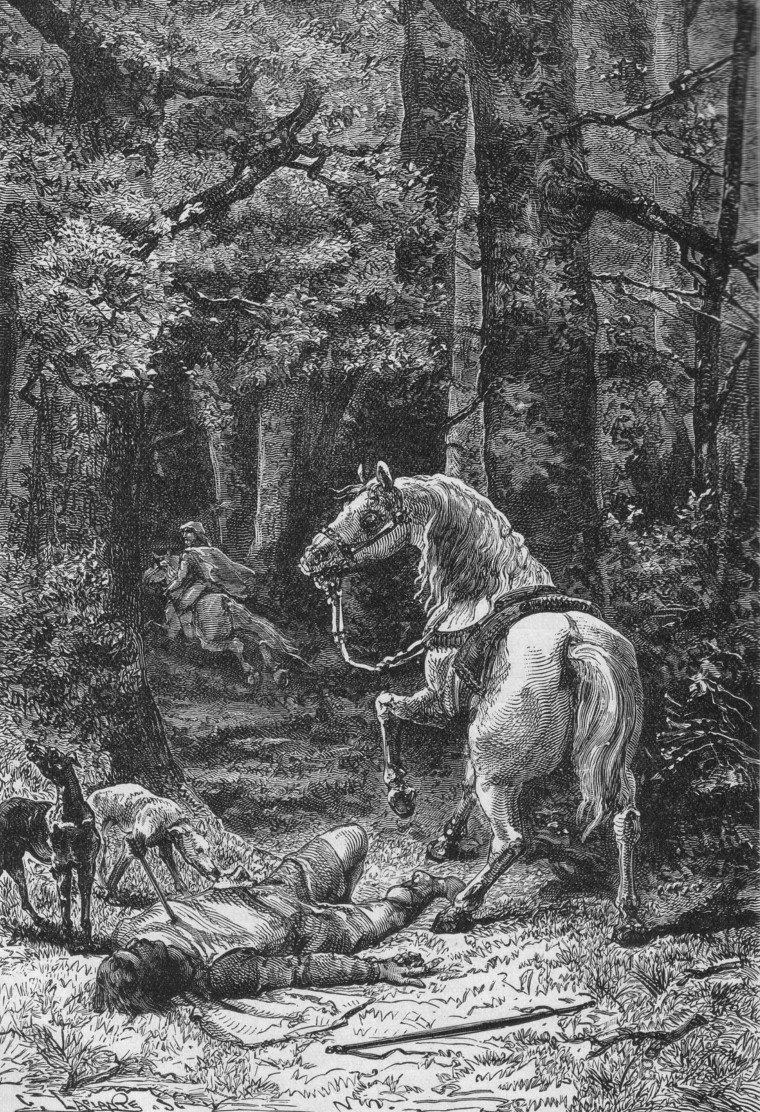
The death of William Rufus, engraving by Alphonse de Neuville, Ridpath’s Universal History, 1895 — a later depiction; no contemporary image survives.
Claim tested
What do the surviving chronicle accounts actually establish about William Rufus’s death, and what has later tradition added to fill the gaps they leave?
Concise verdict
The earliest source, the Anglo-Saxon Chronicle, records only that the king was shot by an arrow by one of his own men while hunting, and does not name the man. The vivid, widely repeated version, naming Walter Tirel, describing an omen the night before, and detailing the exact shot, comes from William of Malmesbury and Orderic Vitalis, both writing roughly a generation after the event, both with an explicit moral or providential framing to advance. No chronicler names a motive for murder, and no medieval or modern investigation of any kind was ever conducted.
Why this claim matters
This case is a useful test of source hierarchy precisely because there is no Tier 1 administrative record to check the narrative against, the way there would be for a case with a surviving inquest or trial. Every popular retelling, and a persistent minority tradition that the king was assassinated on his brother Henry’s orders, draws entirely on chronicle sources written twenty-eight to forty years after the event. Distinguishing what the earliest surviving account says from what later, more colourful, more motivated accounts added is the whole of what can be done here, and it is worth doing precisely because the temptation to treat a good story as settled fact is strongest where no record exists to correct it.
Chronology
2 AUGUST 1100
William II leads a hunting party into the New Forest, near Brockenhurst. Companions include his brother Henry, Walter Tirel, Gilbert de Clare, and Roger de Clare. The party disperses in pursuit of deer. William is struck in the chest by an arrow and dies at or near the scene.
SAME DAY
The hunting party disperses without recovering the body in any organised way. Walter Tirel leaves England for France and does not return to answer any accusation, formal or otherwise. William’s brother Henry rides directly to Winchester rather than remaining with the body.
3 AUGUST 1100
Henry secures the royal treasury at Winchester and is crowned king within days, before his elder brother Robert Curthose, then returning from crusade with a strong rival claim, can contest the succession. The king’s body is recovered by a local charcoal-burner, Purkis, and carried to Winchester Cathedral by cart. He is buried with minimal ceremony.
EARLY-MID 12TH CENTURY
William of Malmesbury (Gesta Regum Anglorum, completed c.1125–1128) and Orderic Vitalis (Historia Ecclesiastica, completed by 1141) each write substantially fuller accounts, decades after the event and after neither had any direct access to it. Both frame the death as providential judgement on an impious king. Neither cites an eyewitness by name for the fatal shot itself.
Source hierarchy
No inquest, coroner’s record, or trial document exists for this death, because none of those institutions existed in their later form in 1100. The Anglo-Saxon Chronicle’s entry for 1100, a near-contemporary monastic annal, is treated as the closest available source to the event. William of Malmesbury and Orderic Vitalis, writing a generation later with explicit moralising aims, are treated as later chronicle elaboration, not as independent corroboration of each other.
Provenance assessment
The Anglo-Saxon Chronicle’s brevity is itself informative: it does not name Tirel, does not describe an omen, and does not offer a motive, where later, more detailed accounts do all three. Malmesbury and Orderic each had reasons, literary and theological, to render Rufus’s death as deserved; neither claims to have spoken to a witness present at the shot. Henry’s rapid coronation is well attested and genuinely unusual in its speed, but speed alone does not establish premeditation.
Contradiction table
A dossier does not smooth over conflicts in the record. Where sources disagree, the disagreement is stated, not resolved by preference for the more commonly repeated version.
| Point of fact | Anglo-Saxon Chronicle | Later chroniclers | Status |
|---|---|---|---|
| Identity of the man who shot the arrow | Not named — “one of his own men” | Named as Walter Tirel (Malmesbury, Orderic) | Added later |
| Omen or dream before the hunt | Not mentioned | Detailed dream and foreboding described (Malmesbury) | Added later |
| Whether the death was accident or assassination | Not addressed either way | Framed as accident by both Malmesbury and Orderic; neither alleges a conspiracy; assassination is a later and modern speculative reading, not a chronicle claim | Unsupported by any source |
Evidential classification
| Claim | Classification |
|---|---|
| William II died from an arrow wound while hunting in the New Forest on 2 August 1100 | Supported |
| Walter Tirel fired the arrow | Probable (consistent later chronicle attribution; absent from the earliest source) |
| Henry’s coronation followed unusually fast | Supported |
| The death was an assassination, ordered or arranged by Henry | Unsupported (no chronicle, contemporary or later, makes this claim; it is a modern speculative inference from circumstance alone) |
| The king had an ominous dream the night before | Unsupported by the earliest source (appears only in Malmesbury, writing a generation later) |
What can safely be said
“William II died from an arrow wound while hunting in the New Forest on 2 August 1100. The earliest surviving account does not name who fired the shot. The familiar version of the story, naming Walter Tirel and describing an omen the king experienced the night before, comes from chroniclers writing a generation later. No source, contemporary or later, claims the death was anything other than an accident.” This is directly supportable from the Anglo-Saxon Chronicle, Malmesbury, and Orderic Vitalis.
Unresolved evidence gaps
No administrative or judicial record of any kind survives for this death, and none was ever created. Whether Tirel fled out of guilt or out of reasonable fear of being blamed regardless of guilt, in a political vacuum with the throne suddenly open, cannot be determined from the surviving sources. This audit states that gap directly rather than resolving it by inference in either direction.
Source schedule
| Source | Type |
|---|---|
| Anglo-Saxon Chronicle, entry for 1100 | Near-contemporary monastic annal — closest surviving source to the event |
| William of Malmesbury, Gesta Regum Anglorum (completed c.1125–1128) | Later chronicle, written a generation after the event |
| Orderic Vitalis, Historia Ecclesiastica (completed by 1141) | Later chronicle, written a generation after the event |
Commission work using this method.
Private dossiers apply the same source hierarchy, provenance assessment, contradiction mapping and evidential classification to your subject — scoped to your specific claim, intended use and deadline.