TBA-010 · Public Evidence Audit
The Trial of Agnes Sampson
Edinburgh, Scotland · January 1591
Agnes Sampson was tortured, confessed to plotting against King James VI by witchcraft, and was executed. Her confession is the evidentiary foundation of the North Berwick witch trials. This audit tests what a confession extracted under judicial torture can legitimately establish, using the source that records it.
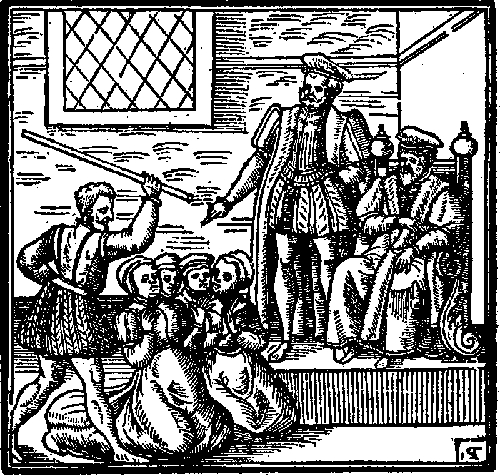
Illustration of accused witches before King James VI, from his Daemonologie, 1597.
Claim tested
What does Agnes Sampson’s confession actually establish, given how it was obtained and who published the account of it?
Concise verdict
The confession establishes that Agnes Sampson, after prolonged physical torture including a body search for a “witch’s mark,” said what her interrogators wanted to hear. It does not establish that a witches’ conspiracy against James VI actually existed. The primary account of the confession, Newes from Scotland, was a pamphlet closely tied to the king’s own circle and published to justify the prosecutions already underway, not a neutral record of what was said.
Why this claim matters
This case is a clean illustration of why a confession’s existence is not the same as its evidentiary weight. Sampson’s confession is often retold as though it were freely given testimony revealing a genuine plot, including the frequently repeated detail that she recited private words from the king’s wedding night, presented in the pamphlet as proof of diabolical knowledge. Reading the same detail against the torture that preceded it, and the propagandistic purpose of the document reporting it, produces a materially different picture of what actually happened in that room.
Chronology
1589–1590
James VI’s sea voyages to and from Denmark, to collect his bride Anne of Denmark, are beset by severe storms. A Danish inquisition into witchcraft blames the storms on sorcery. On his return, James takes a personal interest in identifying a similar conspiracy in Scotland.
NOVEMBER 1590
Geillis Duncan, a servant near Tranent suspected by her employer David Seaton of unusual healing abilities, is tortured and searched for a “witch’s mark.” She confesses and names others, including Agnes Sampson, a healer and midwife already under suspicion by the Haddington Presbytery.
LATE 1590
Sampson is arrested, interrogated, and tortured, her hair shaved and her head bound tightly with rope for close to an hour. Newes from Scotland reports the discovery of a “witch’s mark,” after which she confesses to whatever is put to her, including attending a witches’ gathering at North Berwick and plotting to sink the king’s ship by storm.
27–28 JANUARY 1591
Sampson is convicted on 27 January and executed the following day, strangled and her body burned, the standard punishment for witchcraft in Scotland at the time. Sources consulted for this audit differ on whether the execution took place at Castle Hill in Edinburgh or at Leith; this audit has not resolved the discrepancy. The wider trials continue into 1591–92 and result in roughly seventy convictions and executions.
Source hierarchy
Newes from Scotland (1591) is treated as the primary contemporary account of the confession, but with an explicit caution attached to its provenance: it was written to justify prosecutions the crown had already undertaken, not as neutral reportage. Kirk session and secular court records for the wider trials exist and are treated as primary where consulted directly, though this audit has relied substantially on published secondary synthesis of them rather than the original session minutes. James VI’s own Daemonologie (1597) is treated as the king’s later justification, not as evidence for the events of 1590–91 themselves.
Provenance assessment
A confession obtained after sustained physical torture, and reported by a pamphlet with a direct interest in confirming the prosecution’s premise, cannot be treated as reliable evidence of the facts it describes, regardless of how specific or vivid its detail. The wedding-night detail, presented by the pamphlet as proof of supernatural knowledge, is at least as consistent with court gossip reaching Sampson by ordinary means as with any occult explanation; the pamphlet does not consider or rule out the mundane explanation.
Contradiction table
A dossier does not smooth over conflicts in the record. Where sources disagree, the disagreement is stated, not resolved by preference for the more commonly repeated version.
| Point of fact | Popular retelling | What the source actually supports | Status |
|---|---|---|---|
| Existence of a real conspiracy against James VI | Often presented as an established plot Sampson exposed | Established only by confessions extracted under torture, reported by an interested pamphlet | Contradicted |
| Execution location | Given variously as Castle Hill, Edinburgh, or Leith across sources | Not resolved by this audit | Unresolved |
Evidential classification
| Claim | Classification |
|---|---|
| Sampson was tortured before confessing | Supported |
| She was convicted and executed in January 1591 | Supported |
| A genuine witches’ conspiracy against the king existed | Unsupported (rests entirely on tortured confessions reported by an interested pamphlet) |
| Sampson’s knowledge of the wedding night was supernatural in origin | Unsupported (a mundane explanation is at least as consistent with the record; the pamphlet does not rule it out) |
What can safely be said
“Agnes Sampson was tortured, confessed under that torture to plotting against James VI, and was executed on 28 January 1591. The pamphlet reporting her confession, Newes from Scotland, was written to justify prosecutions already underway and cannot be treated as a neutral record. The confession establishes what Sampson said under duress, not that a genuine conspiracy existed.” This is directly supportable from Newes from Scotland and the secondary scholarship on the trials.
Unresolved evidence gaps
This audit has relied on published secondary treatment of the Kirk session and secular court records rather than direct inspection of the original minutes. The precise execution location is unresolved across the sources consulted. Newes from Scotland’s authorship remains debated among historians and has not been settled here.
Source schedule
| Source | Type |
|---|---|
| Newes from Scotland (1591) | Primary contemporary pamphlet — closely tied to the crown’s own interest, not neutral |
| Kirk session and secular court records of the wider trials | Primary — consulted via secondary synthesis for this audit |
| James VI, Daemonologie (1597) | Later royal justification — not evidence for 1590–91 events |
Commission work using this method.
Private dossiers apply the same source hierarchy, provenance assessment, contradiction mapping and evidential classification to your subject — scoped to your specific claim, intended use and deadline.