TBA-012 · Public Evidence Audit
King Arthur
Britain · 5th–6th century (claimed)
No source written within centuries of Arthur’s supposed lifetime names him. This audit maps exactly when each element of the familiar story enters the written record, against when the events themselves are supposed to have happened.
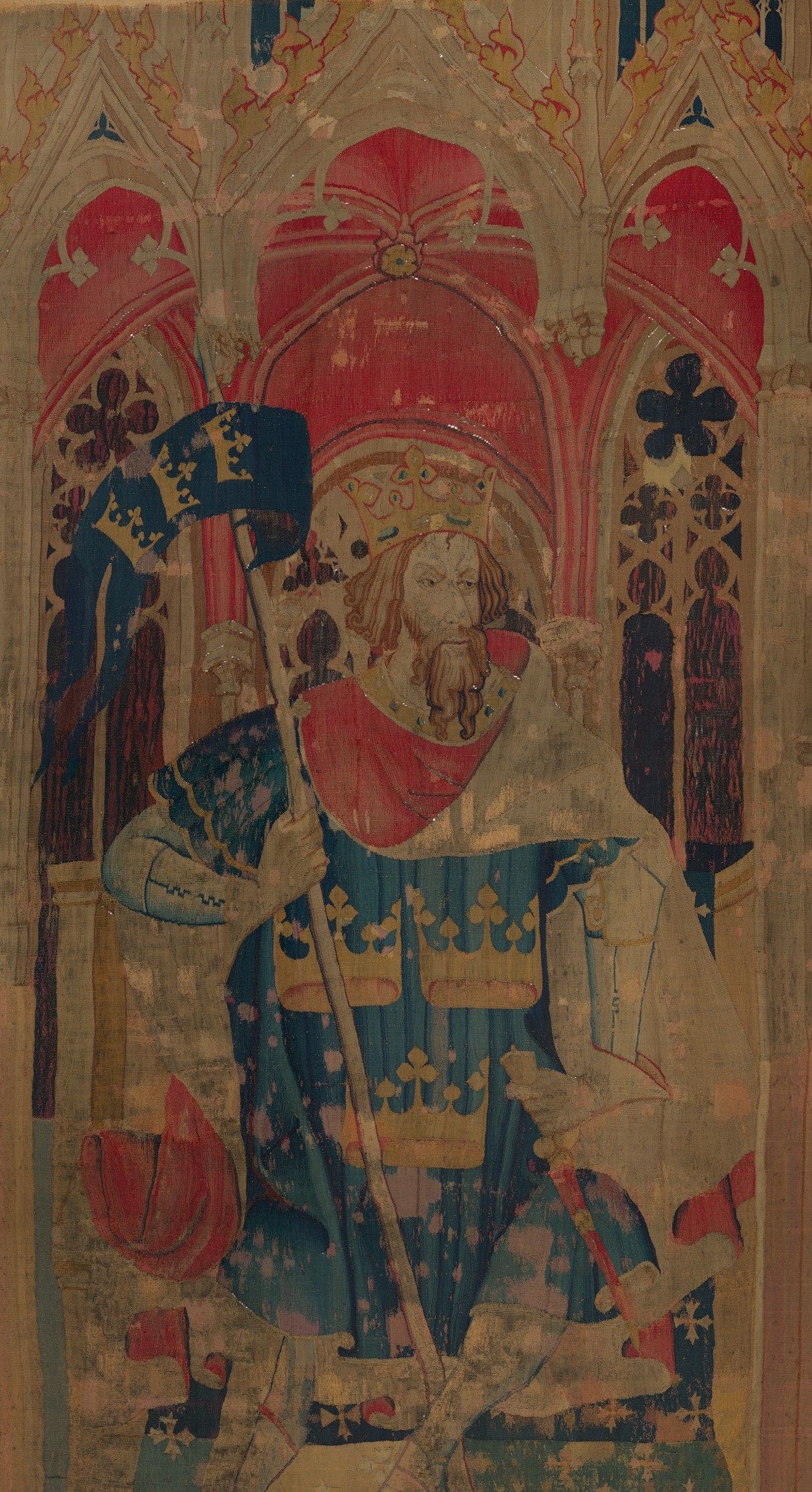
King Arthur, detail from the Nine Heroes Tapestries, c.1400, Metropolitan Museum of Art.
Claim tested
What is the earliest surviving reference to Arthur, what does it actually claim, and when does the familiar figure of a king with a court, a wizard, and a magic sword enter the record?
Concise verdict
Gildas, writing in the 6th century, closest in time to any historical Arthur, describes the Battle of Badon without naming Arthur at all. The first text to name him, Nennius’s Historia Brittonum, was written around 830, roughly three centuries after the claimed events, and calls him a battle-leader, not a king, in a passage that already contains clearly legendary material. The king with a court, a wizard, and a named sword is a 12th-century literary construction, introduced by Geoffrey of Monmouth roughly six hundred years after the events he describes.
Why this claim matters
Arthur is often defended by pointing to “early” sources without stating how early relative to what. The gap between the claimed events and the first source that names Arthur is roughly the same gap as between the present day and the reign of Henry VIII. The gap between the events and the source that actually invents the king-with-a-court version most people picture is roughly the same span as between the present day and the founding of the United States. Stating those gaps in years, rather than in the vague language of “ancient tradition,” is the entire distortion analysis.
Chronology
c. 500–550 (CLAIMED PERIOD)
The period in which a historical Arthur, if one existed, is supposed to have led British resistance against Saxon settlement, culminating in the Battle of Badon.
6TH CENTURY
Gildas writes De Excidio Britanniae, the source closest in time to the claimed events. He describes the Battle of Badon and a period of fluctuating fortune between Britons and Saxons. He does not name Arthur in connection with Badon or anything else.
c. 830 (ROUGHLY 300 YEARS LATER)
Nennius’s Historia Brittonum is the first surviving text to name Arthur, calling him dux bellorum, leader of battles, fighting alongside British kings rather than being one himself. The same passage credits him with personally killing 960 men in a single battle and carrying an image of the Virgin Mary on his shoulders, legendary embellishment present from this earliest naming, not added later.
10TH CENTURY
The Annales Cambriae, a Welsh chronicle, links Arthur to Badon and to the Battle of Camlann, where he and Medraut (later Mordred) both fall. The entries are brief annal notices, not narrative.
c. 1136 (ROUGHLY 600 YEARS LATER)
Geoffrey of Monmouth’s Historia Regum Britanniae transforms Arthur from a battle-leader into a king who conquers an empire, introduces a named sword (Caliburn), a specific enemy (Cheldric), and the literary machinery, Merlin’s prophecy included, that all later medieval romance builds on. Modern Arthurian scholars, including the director of Bangor University’s Centre for Arthurian Studies, describe Geoffrey’s role as something close to inventing the king-with-a-court version of Arthur.
Source hierarchy
Gildas’s De Excidio Britanniae is treated as the closest available source to any historical events, and its silence on Arthur is treated as evidentially significant, not neutral. Nennius’s Historia Brittonum is the earliest source naming Arthur, but is written centuries later and already contains legendary material. The Annales Cambriae is a later chronicle tradition. Geoffrey of Monmouth’s Historia Regum Britanniae is treated strictly as literary construction, not as evidence for the 6th century.
Provenance assessment
An argument from silence is not proof that Arthur did not exist; Gildas’s brevity and selectivity as a moralising writer are well documented and he omits many figures. But the near-universal scholarly reliance on Nennius as the “earliest” Arthur source should be stated with its actual distance from the claimed events attached, roughly three centuries, rather than left as an unspecified “early” claim.
Contradiction table
A dossier does not smooth over conflicts in the record. Where sources disagree, the disagreement is stated, not resolved by preference for the more commonly repeated version.
| Point of fact | Popular tradition | Earliest sources | Status |
|---|---|---|---|
| Arthur’s title | King | Nennius: dux bellorum (battle-leader), not a king | Contradicted |
| Contemporary evidence for Arthur’s existence | Often assumed to exist somewhere in the record | None: Gildas, the closest source in time, does not mention him | Unsupported |
Evidential classification
| Claim | Classification |
|---|---|
| A Battle of Badon was fought against Saxon forces in the early 6th century | Supported (Gildas, near-contemporary) |
| Arthur existed as a named historical battle-leader | Unsupported by any contemporary source (earliest naming is roughly three centuries later) |
| Arthur was a king who ruled a court at Camelot | Unsupported (literary invention, 12th century, roughly six centuries after the claimed events) |
| A named sword and a wizard named Merlin featured in the original tradition | Unsupported (absent from Nennius and the Annales Cambriae; introduced by Geoffrey of Monmouth) |
What can safely be said
“No source written within Arthur’s claimed lifetime names him. The first text to name him, roughly three centuries later, calls him a battle-leader, not a king, and already contains clearly legendary material. The familiar king-with-a-court version of Arthur is a 12th-century literary construction, roughly six centuries removed from the events it claims to describe.” This is directly supportable from Gildas, Nennius, the Annales Cambriae, and Geoffrey of Monmouth’s Historia Regum Britanniae.
Unresolved evidence gaps
Whether Gildas’s silence reflects Arthur’s non-existence or simply his own selective focus cannot be resolved from the sources themselves. The dating of the poem Y Gododdin’s reference to Arthur, which some scholars place earlier than Nennius, is contested because the poem survives only in a much later manuscript, and this audit does not adopt a position on its reliability as an early witness.
Source schedule
| Source | Type |
|---|---|
| Gildas, De Excidio Britanniae (6th century) | Primary — closest surviving source to the claimed period; does not name Arthur |
| Nennius, Historia Brittonum (c. 830) | Earliest source naming Arthur; roughly three centuries removed from the claimed events |
| Annales Cambriae (10th century) | Later chronicle tradition |
| Geoffrey of Monmouth, Historia Regum Britanniae (c. 1136) | Literary construction — origin of the king-with-a-court tradition |
Commission work using this method.
Private dossiers apply the same source hierarchy, provenance assessment, contradiction mapping and evidential classification to your subject — scoped to your specific claim, intended use and deadline.