TBA-013 · Public Evidence Audit
The Arrow That Found Achilles
Classical tradition · Trojan War cycle
Homer’s Iliad, the earliest and most authoritative source for Achilles, never once mentions a vulnerable heel. This audit traces exactly when, and by whom, the single-weak-point version of the story was introduced.
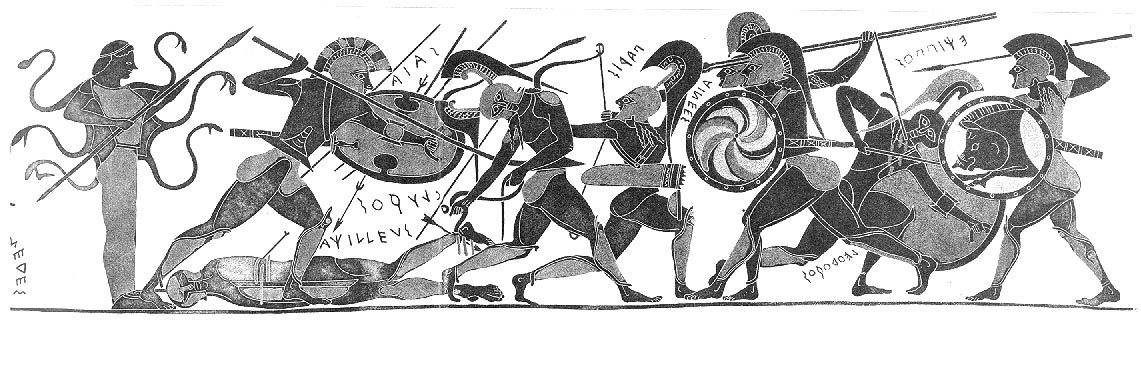
The death of Achilles, drawing after a lost Chalcidian vase, c.540-530 BCE.
Claim tested
Does Homer’s Iliad describe Achilles as invulnerable except for his heel, and where does that specific detail actually originate?
Concise verdict
No. The Iliad presents Achilles as straightforwardly mortal and fated to die at Troy, with no invulnerability of any kind, and his death is not even depicted within the poem. The heel as a specific point of weakness, created when Thetis dipped the infant Achilles in the River Styx while holding him by the heel, first appears in the Achilleid, an unfinished poem by the Roman writer Statius, composed around 95 CE, roughly eight hundred years after Homer.
Why this claim matters
“Achilles’ heel” is used as a byword for a single hidden weakness, treated as though it were bedrock ancient Greek myth. It is a Roman literary addition made eight centuries after the character’s foundational appearance, and it is not even the earliest attempt to explain how a nearly-invincible warrior could die: an earlier tradition, recorded by Apollonius of Rhodes in the third century BCE, has Thetis using fire and ambrosia, not water, with no heel involved at all. The version everyone knows displaced an older, different version, and neither is in Homer.
Chronology
c. 8TH CENTURY BCE
Homer’s Iliad presents Achilles as mortal and fated to die at Troy. In Book 22, Hector prophesies Achilles will be killed by Paris and Apollo. Book 18 describes Thetis obtaining new armour for her son from Hephaestus, not an invulnerability ritual of any kind. The poem ends before Achilles’ death occurs.
c. 8TH–6TH CENTURY BCE
The Aethiopis, part of the lost Epic Cycle attributed to Arctinus, is understood to have narrated Achilles’ actual death, but the text does not survive and its specific details cannot be verified directly.
3RD CENTURY BCE
Apollonius of Rhodes, in the Argonautica, records a tradition in which the infant Achilles is anointed with ambrosia and held in fire by Thetis to burn away his mortality. This version involves no water, no Styx, and no single vulnerable point.
1ST CENTURY BCE
Virgil’s Aeneid is the first surviving source to state explicitly that Apollo guided Paris’s arrow to kill Achilles. It does not specify a particular point of vulnerability.
c. 95 CE (ROUGHLY 800 YEARS AFTER HOMER)
The Roman poet Statius, in his unfinished Achilleid, is the first surviving source to describe Thetis dipping the infant Achilles in the River Styx while holding him by the heel, rendering his whole body invulnerable except for that one point. This is the specific origin of the “Achilles’ heel” tradition as it is known today.
Source hierarchy
Homer’s Iliad is treated as the foundational and earliest surviving source for Achilles. Apollonius’s Argonautica and Virgil’s Aeneid are treated as intermediate classical sources, each closer to Homer than to Statius but still centuries removed from the Iliad. Statius’s Achilleid is treated as the specific origin point of the heel tradition, a distinct Roman literary innovation, not a transcription of older Greek material.
Provenance assessment
The absence of the heel motif from Homer, Apollonius, and Virgil, three independent sources spanning roughly seven centuries before Statius, is a strong basis for treating it as a distinct later addition rather than an older tradition simply unattested until Statius happened to record it. Some modern classical scholarship has proposed a Hellenistic-era source for Statius’s version, which would push the origin earlier than the 1st century CE but still well after Homer; this audit treats that proposal as plausible but unconfirmed.
Contradiction table
A dossier does not smooth over conflicts in the record. Where sources disagree, the disagreement is stated, not resolved by preference for the more commonly repeated version.
| Point of fact | Popular tradition | Earliest sources | Status |
|---|---|---|---|
| Method of Achilles’ near-invulnerability | Dipped in the River Styx, held by the heel | Apollonius (3rd c. BCE): anointed with ambrosia and held in fire; no Styx, no heel | Contradicted |
| Presence of invulnerability in Homer | Often assumed to be original to the Iliad | Entirely absent; Achilles is presented as ordinarily mortal throughout | Contradicted |
Evidential classification
| Claim | Classification |
|---|---|
| Homer presents Achilles as fated to die at Troy | Supported |
| Achilles’ death occurs within the Iliad itself | Unsupported (the poem ends before it happens) |
| The heel-vulnerability story is original Greek myth predating Homer | Unsupported (first appears in a Roman poem roughly 800 years after Homer) |
| Statius’s Achilleid is the origin of the specific heel/Styx detail | Supported (no earlier surviving source contains it) |
What can safely be said
“Homer’s Iliad presents Achilles as an ordinarily mortal warrior with no invulnerability and no vulnerable heel; his death is not depicted in the poem at all. The familiar story, that Thetis dipped him in the River Styx by the heel, first appears roughly eight hundred years later, in a Roman poem by Statius, and even then it displaced an earlier, different tradition involving fire rather than water.” This is directly supportable from the Iliad, the Argonautica, the Aeneid, and Statius’s Achilleid.
Unresolved evidence gaps
The lost Aethiopis may have contained an earlier version of Achilles’ death and its circumstances, but the text does not survive and this audit cannot characterise its content directly. Whether Statius drew on an earlier, now-lost Hellenistic source, as some modern classicists have proposed, remains an open scholarly question this audit does not resolve.
Source schedule
| Source | Type |
|---|---|
| Homer, Iliad (c. 8th century BCE) | Primary — foundational source; no invulnerability or heel motif present |
| Apollonius of Rhodes, Argonautica (3rd century BCE) | Intermediate source — fire/ambrosia tradition, no heel |
| Virgil, Aeneid (1st century BCE) | Intermediate source — names Apollo’s guidance, no specific weak point |
| Statius, Achilleid (c. 95 CE) | Origin point of the heel/Styx tradition as known today |
Commission work using this method.
Private dossiers apply the same source hierarchy, provenance assessment, contradiction mapping and evidential classification to your subject — scoped to your specific claim, intended use and deadline.