TBA-015 · Public Evidence Audit
The Commission at Brentwood
Brentwood, Essex · 30 May 1381
Every account of the incident that helped trigger the Peasants’ Revolt identifies the royal official confronted at Brentwood as a tax commissioner named Thomas Bampton, newly sent to collect the poll tax. This audit checks that identification against the Crown’s own enrolled record of every commission it issued him.
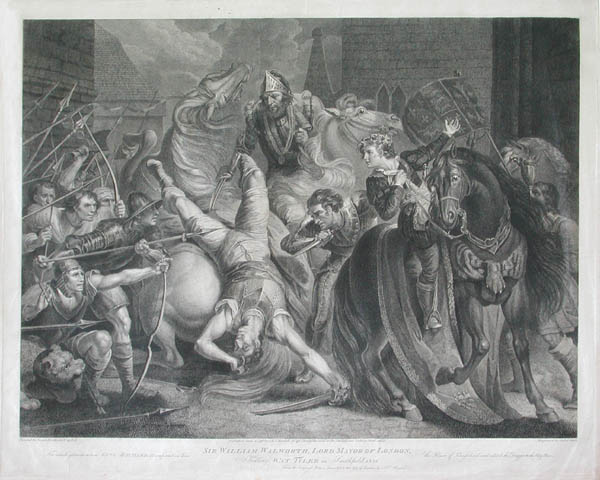
Sir William Walworth killing Wat Tyler at Smithfield, 1381 — engraving by Anker Smith after James Northcote, 1796. General Peasants’ Revolt imagery; no image specific to the Brentwood commission survives.
Claim tested
What does the Calendar of the Patent Rolls establish about the royal official confronted at Brentwood on 30 May 1381, and about the authority he held that day?
Concise verdict
The chronicle names him Thomas Bampton, a newly appointed tax commissioner. The Crown’s own enrolled record names him John, gives him a documented career spanning a decade of Essex commissions, and ties him to a commission of the peace six months before Brentwood, not to the poll tax. The name is settled. The tax connection is not confirmed by this record, and the record does not say what authority, if any, sent him to that field in May.
Why this claim matters
Brentwood is treated as the ignition point of the largest popular uprising in medieval English history, and the chronicle’s framing of Bampton as a tax commissioner has gone unchecked against the administrative record for six hundred and forty-five years. With a major film dramatising the 1381 uprising released this year, renewed public attention makes this exactly the kind of unexamined assumption worth testing against the primary record before it is repeated again.
Chronology
26 OCTOBER 1380
An Essex commission of the peace is sealed at Westminster, naming Thomas de Wodestok (earl of Buckingham, constable of England), Walter Fitzwauter, Robert Bealknap, Henry Asty, Thomas Tirell, Thomas Maundevill, John de Gildesburgh, William Berland, Richard de Sutton, Clement Spice, John Bataill, Geoffrey Dersham, and Robert Rikedon. John Bampton is not among them.
12 NOVEMBER 1380
A second Essex commission of the peace is sealed at Northampton, on the same membrane as the first, with a revised roster: Thomas, earl of Buckingham, Walter Fitzwauter, Robert Bealknap, Henry Asty, Robert Marny, Thomas Tyrell, John Gildesburgh, William Wauton, John Bampton, and William Paclysham. This is the only royal appointment on Bampton’s enrolled record anywhere near the date of Brentwood.
30 MAY 1381
A royal official named Bampton sets up at Brentwood, in Essex, and summons representatives from Fobbing, Corringham, and Stanford-le-Hope to answer to him. They refuse. The confrontation turns violent, and one man is arrested. The Anonimalle Chronicle, the near-contemporary source for this sequence, frames Bampton as newly appointed to collect the poll tax, without stating the source of that authority.
EARLY JUNE 1381
A second royal officer, Robert Belknap, arrives at Brentwood separately, days after the initial confrontation, to deal with the aftermath. Belknap is also named on the 12 November peace commission, alongside Bampton.
1906
Charles Oman’s translation of the Anonimalle Chronicle renders the commissioner’s name as Thomas Bampton. This translation becomes the primary route by which most subsequent popular and academic accounts access the source, and the name Thomas propagates from it.
Source hierarchy
The Calendar of the Patent Rolls, Richard II, 1377–1381 (HMSO, 1895) — checked directly against the digitised HathiTrust scan of the University of Michigan copy, page 571, Membrane 32d, and cross-checked against the volume’s own General Index — sits as the primary administrative record. The Anonimalle Chronicle, via Oman’s 1906 translation, is treated as near-contemporary narrative, not administrative fact. Knighton’s Continuator, a separate and later chronicle tradition, is treated as an independent narrative source, not as corroboration of Anonimalle.
Provenance assessment
The 12 November 1380 commission was verified by direct inspection of the digitised patent roll page, not taken from a secondary transcription. The General Index entry for “Bampton, John de, of co. Essex” was checked directly and lists ten pages across four years, none corresponding to a poll-tax or subsidy commission. A separate poll-tax evasion-review commission, referenced in modern scholarship as dating to March 1381, has not been located in this volume and is not confirmed to involve Bampton.
Contradiction table
A dossier does not smooth over conflicts in the record. Where sources disagree, the disagreement is stated, not resolved by preference for the more commonly repeated version.
| Point of fact | Chronicle tradition | Patent roll record | Status |
|---|---|---|---|
| Commissioner’s first name | Thomas (Oman’s 1906 translation) | John, consistently, across ten pages | Contradicted |
| Bampton’s role at Brentwood | Newly appointed tax commissioner | No tax commission on record; nearest documented authority is a peace commission from six months earlier | Unconfirmed |
| Identity of the arrested spokesman | Not named in Anonimalle; named as Thomas Baker only in Knighton’s Continuator, a separate tradition | Not a Patent Rolls matter | Unconfirmed |
| Bampton’s presence on the October 1380 Essex peace commission | Not addressed in chronicle sources | Absent from the 26 October roster; present only on the revised 12 November roster six weeks later, for reasons the roll does not state | Unresolved |
Evidential classification
| Claim | Classification |
|---|---|
| A royal official named Bampton was confronted at Brentwood on 30 May 1381 | Supported |
| His given name was John, not Thomas | Supported (Patent Rolls, General Index) |
| Bampton held a commission of the peace for Essex from 12 November 1380 | Supported |
| Bampton was appointed to collect the poll tax | Unsupported by the Patent Rolls (no tax commission appears in his ten-page index entry; a possible unenrolled or otherwise-recorded instrument cannot be ruled out) |
| The man arrested at Brentwood was Thomas Baker | Unsupported (absent from the earliest chronicle account; sourced only to a separate, later tradition) |
What can safely be said
“The royal official confronted at Brentwood on 30 May 1381 was John Bampton, not Thomas as most modern accounts state. The Crown’s enrolled record ties him to a commission of the peace for Essex from six months earlier. It does not confirm the tax-collector role the chronicle tradition assigns him.” This is directly supportable from the Patent Rolls and its General Index.
Unresolved evidence gaps
A poll-tax evasion-review commission dated March 1381 is referenced in secondary scholarship on the revolt but has not been located in the Calendar of the Patent Rolls for this audit. Whether such an instrument existed, whether it named Bampton, and whether it was enrolled elsewhere or not enrolled at all, remain open. Why Bampton was added to the Essex peace commission between the 26 October and 12 November rosters is not stated anywhere in the surviving record. This audit states these gaps directly rather than resolving them by inference.
Source schedule
| Source | Type |
|---|---|
| Calendar of the Patent Rolls, Richard II, 1377–1381 (HMSO, 1895), p. 571, Membrane 32d — checked directly against the HathiTrust digitisation (id: mdp.39015009337620) | Primary — Crown enrolled record |
| General Index, Calendar of the Patent Rolls, Richard II, 1377–1381, s.v. “Bampton, John de, of co. Essex” | Primary — Crown enrolled record, index |
| Anonimalle Chronicle, trans. Charles Oman (1906) | Near-contemporary narrative |
| Knighton’s Continuator (Chronicon) | Later, separate chronicle tradition |
Commission work using this method.
Private dossiers apply the same source hierarchy, provenance assessment, contradiction mapping and evidential classification to your subject — scoped to your specific claim, intended use and deadline.