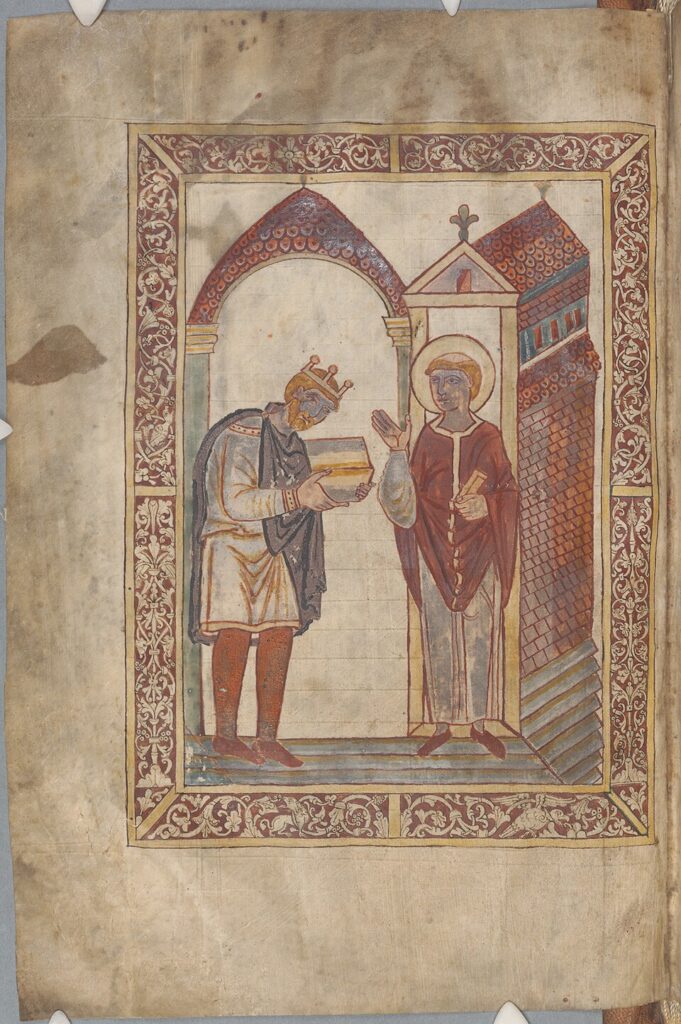
Image above: the frontispiece of Bede’s Life of St Cuthbert, circa 930, showing King Æthelstan presenting the book to the saint himself — the earliest surviving portrait of an English king made from life.
Æthelstan’s path to the throne began somewhere unusual for a son of the West Saxon royal house: in Mercia, in the court of his aunt Æthelflæd, where he was raised and trained rather than in his father Edward the Elder’s household in Wessex. When Edward died in 924, it was Mercian nobles who moved first, acclaiming Æthelstan king in Mercia while Wessex hesitated. The West Saxon nobility did not accept him for well over a year, a delay the sources attribute variously to questions about his mother’s status and the claims of a rival, and it was not until 4 September 925, at Kingston-upon-Thames, that he was crowned in a ceremony with a title that had not been used before in quite the same way: not King of Wessex, not King of Mercia, but rex Anglorum — King of the English.
Evidence tier: PROVEN for the sequence — Mercian acclamation in 924, delayed Wessex acceptance, coronation at Kingston in September 925 — attested across the Anglo-Saxon Chronicle and near-contemporary charter witness lists. Evidence tier: DISPUTED for the precise reason Wessex hesitated; the sources gesture at a dispute over legitimacy and a rival claimant without settling the matter definitively, and historians continue to debate exactly what happened in that missing year.
Finishing What His Aunt Started
Æthelstan’s Mercian upbringing was not incidental to what came next. He had been trained inside the burh system Æthelflæd built, moved among the Mercian noble families who had served her, and understood — in a way a purely West Saxon-raised king might not have — how that fortress network functioned as both defence and logistics. In 927 he did what his aunt’s death in 918 had prevented: he took York. The Norse leadership there had offered Æthelflæd their submission nine years earlier; Æthelstan achieved the same result by conquest instead, folding the last major Viking stronghold in England into a single kingdom for the first time.
The submission that followed, on 12 July 927 at Eamont Bridge near Penrith, is one of the best-documented diplomatic moments of the entire Anglo-Saxon period: Constantine II, King of Alba (Scotland); Hywel Dda, King of Deheubarth in Wales; Ealdred of Bamburgh, ruler of the remaining independent Northumbrian territory; and Owain, King of Strathclyde, all came to Æthelstan and acknowledged his overlordship. Evidence tier: PROVEN, attested independently in multiple chronicle traditions, including sources written outside Æthelstan’s own kingdom with no obvious motive to flatter him.
The Administrative Kingdom
What separates Æthelstan from Offa, a century earlier, is what he did with the authority once he had it: he did not merely hold it, he built structures designed to survive him. The law code issued at Grately in Hampshire established a genuinely national standard — a single coinage, minted only at authorised towns, no longer varying region by region; a unified approach to policing theft and enforcing oaths; and administrative expectations applied, at least in principle, across the whole of his kingdom rather than kingdom by former kingdom. His coins carry a title Offa never claimed and Æthelflæd never lived to see used: rex totius Britanniae, king of all Britain. It was an assertion, not an uncontested fact on the ground — Constantine of Alba would later break with him, and Æthelstan would have to fight to hold what the coinage claimed — but it marks a genuine shift in ambition from “king of a hegemony” to “king of a state.”
Evidence tier: PROVEN for the Grately code’s content and the rex totius Britanniae coin legend, both directly attested in surviving primary documents. Evidence tier: INFERENCE for how completely the administrative unification was actually enforced on the ground outside southern England; law codes state intent, and the degree of practical compliance in more distant or recently conquered regions is less well documented.
Brunanburh
The coalition Æthelstan had assembled at Eamont did not hold. In 937, Constantine II of Alba, Owain of Strathclyde, and the Norse-Irish king Olaf Guthfrithson combined their forces against him in what became the Battle of Brunanburh — the site itself still disputed by historians, though the scale of the engagement is not. The Anglo-Saxon Chronicle marks the victory with an unusually long and formal poem, rare treatment for a single battle, describing it as the greatest slaughter in the island’s history to that point and naming five kings and seven earls among the dead on the losing side. Æthelstan’s forces won decisively, using logistics and mobility built on the same burh infrastructure his aunt had constructed a generation before.
Evidence tier: PROVEN for the battle, its outcome, and its scale, corroborated across multiple independent chronicle traditions including Irish and Welsh annals with no reason to overstate a West Saxon king’s victory. Evidence tier: DISPUTED for the precise location, which remains a genuinely unresolved question in current scholarship, with several sites across northern England and southern Scotland proposed on different grounds.
Death and a Peaceful Succession
Æthelstan died on 27 October 939 at Gloucester, having reigned fifteen years. He was succeeded, without the succession crisis that undid Offa’s line or the annexation that ended Æthelflæd’s, by his half-brother Edmund. That smoothness is itself a form of evidence: a kingdom whose transfer of power did not require civil war or outside intervention was, by the standard of ninth- and early tenth-century England, a genuinely unusual achievement.
Three generations of one family answered the same question in three different ways. Alfred answered it with survival — keeping Wessex alive against the Great Heathen Army when its extinction looked entirely plausible. Æthelflæd answered it with infrastructure — a network of fortresses and, through them, an administrative geography that outlived her own reign. Æthelstan answered it with permanence — a single law, a single coinage, a title that claimed the whole island, and a peaceful handover of power to the next man in line. He did not build alone. He was raised inside his aunt’s system, and what he made permanent, she had already made possible.
Sources: Anglo-Saxon Chronicle (multiple recensions, including the Brunanburh poem); Michael Wood, “The Making of King Æthelstan’s Empire”; Sarah Foot, Æthelstan: The First King of England (Yale University Press); the Grately law code (II Æthelstan); Corpus Christi College, Cambridge, MS 183, f.1v (source of the frontispiece portrait).
Featured image: frontispiece of Bede’s Life of St Cuthbert, Corpus Christi College, Cambridge, MS 183, f.1v, circa 930. Public domain, faithful photographic reproduction of a work of art in the public domain, via Wikimedia Commons.