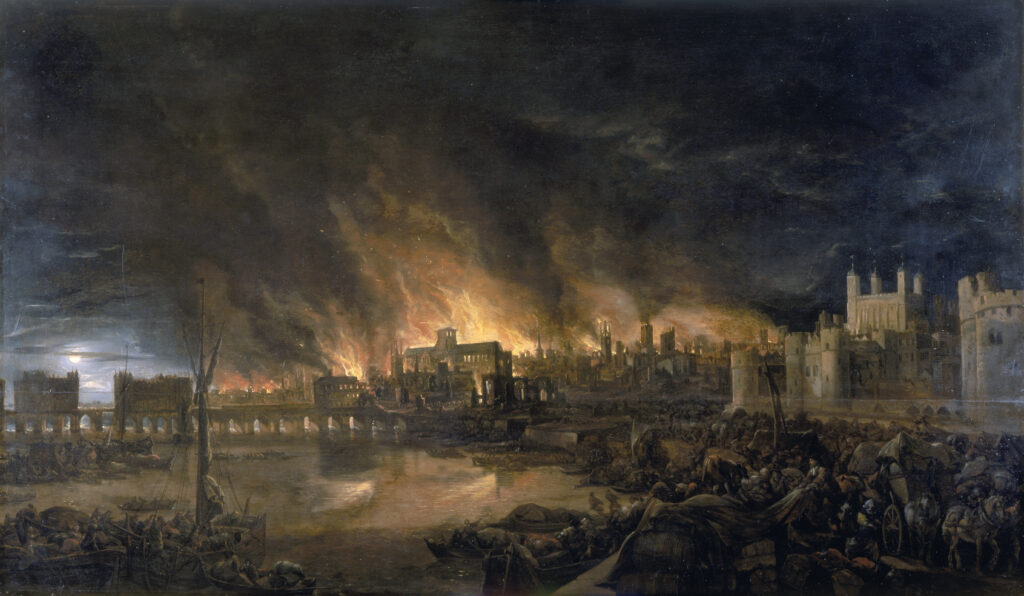
Image above: The Great Fire of London, unknown Dutch School artist, circa 1666–1700. Public domain, via Wikimedia Commons.
John Lowman put Robert Hubert to a test. Taking him through the ruins of Pudding Lane, the constable tried to steer him toward other burned-out buildings, to see whether Hubert would still find his way to the right one. He did: Hubert identified the accepted site of Thomas Farriner’s house in Pudding Lane. It survives as one of the more striking pieces of evidence in the case against him — and one of the more revealing about what that evidence can and cannot prove.
Hubert was hanged at Tyburn for deliberately starting the fire. The surviving translated indictment charges him with setting fire to Thomas Farriner’s house in Pudding Lane and records a guilty verdict. It describes him not as a watchmaker but as “late of London, labourer” — the occupation later tradition attaches to him is not what the prosecution’s own document says. Multiple strong institutional and scholarly sources place the execution on 27 October 1666, though the original execution record itself has not yet been inspected, so the date is treated here as well supported rather than beyond challenge.
What survives from the prosecution
What does not survive is more striking than what does: the evidence actually heard at Hubert’s trial has not survived. What remains is the indictment itself, which names several people on the prosecution side — among them Robert Penny, Francis Gurne (or Grive) and three members of the Farriner family. It is common to see this list turned into “three Farriners on the jury.” The surviving indictment gives no basis for that claim; these are prosecution-side names, not a verified jury list, and no jury list has been located. Because the trial evidence itself is gone, the frequently repeated claim that “the only evidence was his confession” is also too absolute — the confession was central to the case, though we cannot safely say that it stood alone.
What Hubert said
What Hubert actually said, and in what order, is harder to reconstruct than the popular story suggests. The surviving 1667 account preserves one version; other tellings, including an earlier claim connected with Westminster, point to more than one stage. Until the earliest examination texts are checked in full, a tidy sequence of changing stories — or a settled answer on whether he recanted before his execution — would create more certainty than the archive currently permits.
Three tests of the confession: the site, the window, the ship
Three strands of evidence are usually weighed against the confession’s reliability.
The site. As the opening test shows, Hubert could return to the exact site even when Lowman tried to mislead him — a detail preserved in the 1667 printed account. It is contemporary evidence, but it proves less than it first appears to: it shows what Hubert knew, not how he came to know it.
The window. The bakery did not simply lack windows, as it is often put online. The evidence that survives is narrower: the household is reported to have denied the particular window Hubert’s account required, while a separate early account has the family escaping the building through a window and a gutter. The dispute is about one specific opening, not about whether the building had windows at all.
The ship. This is the strand most changed by closer inspection, and it deserves its own treatment.
The Peterson problem
A statement attributed to a shipmaster named Laurence Peterson, dated 1681 and printed by 1713, says that Hubert did not go ashore until two days after the Fire began. If accurate, this would go a long way toward an alibi. It should not be dismissed as a purely modern invention: a London Museum catalogue record for the 1713 printed source in which the statement appears gives it a real, traceable provenance older than any website repeating it.
But the chain matters as much as the claim. The Fire was in 1666. The statement attributed to Peterson is dated 1681 — fifteen years later. Its surviving printed appearance dates from 1713 — forty-seven years after the Fire. Neither the original 1681 statement nor the full 1713 printed text has been examined for this piece; only the museum’s catalogue description of the object has been inspected. Nor is the vessel’s identity settled: the claim that it was definitively the Maid of Stockholm is not supported by the sources checked here, and no contemporary shipping log establishing Hubert’s presence aboard until early September 1666 has been found, despite that claim also circulating as though it were settled.
Who is speaking?
None of the surviving testimony comes from a disinterested source. Weighing it means asking, source by source, how close each witness stood to events, what interest they had in the outcome, and how independent their account really is.
The 1667 printed account is a partisan, unauthorised publication tied to the parliamentary inquiry, not a neutral trial transcript, so its statements need to be weighed one at a time rather than accepted as an official record. The Farriner household’s account survives only at second hand, reported through Samuel Pepys’s account of what Sir Robert Vyner told him; the family had an obvious evidential interest in the outcome of the window dispute, and Pepys is reporting what he was told, not what he witnessed. Clarendon later described Hubert in terms that reflected serious doubts about his guilt and reliability as a witness; the exact original wording has not yet been checked in a scholarly or early edition, so it is presented as reported and attributed rather than as a verified quotation.
The Peterson strand is the most distant of all: a later printed source with a documented gap between the events and their record. The weakness is different in each case: some accounts are interested, some second-hand, some late. None gives us an entirely independent view of what happened.
How Hubert became political evidence
Whatever the truth of Hubert’s guilt, his confession had a long afterlife independent of the evidence behind it.
1666. Hubert confesses amid the suspicion and conspiracy-thinking that followed the Fire and, after conviction, is hanged in October.
1667. The partisan printed account of the parliamentary inquiry sets Hubert’s case within the era’s wider discourse of Catholic plot.
1679. That printed account is reprinted, as Popish Plot politics revive interest in the Fire as evidence of conspiracy.
1681. An anti-Catholic plaque near Pudding Lane names Hubert as the agent of the Papists — the same year as the date attached to the Peterson statement, fifteen years after the Fire.
Historians Frances Dolan, Alan Marshall and Andrea McKenzie have shown how memories of the Fire became entangled with Restoration conspiracy politics and anti-Catholic fears in the years that followed. None of this scholarship strengthens the case against Hubert; it explains why his story kept being retold, and reshaped, long after 1666.
What remains unproved
Several elements of the familiar story remain genuinely open. Hubert’s occupation is unresolved: he may have belonged to a watchmaking family in Rouen, though the indictment calls him a labourer. His religion is similarly unsettled, with no parish or family record so far found to settle it either way. The vessel’s name, the sequence of his statements, whether he recanted, and why he confessed at all are still open questions. Lowman’s account records a degree of lameness, but nothing in the early evidence supports the stronger claim of disabling paralysis. Nor is there evidence here to support torture, coercion or a modern psychiatric explanation for his confession.
Conclusion
The surviving evidence gives substantial reason to doubt Robert Hubert’s conviction. His confession was central to a prosecution whose actual trial evidence has not survived, senior contemporaries are reported to have doubted his guilt, and several of the details that made later accounts of the case appear stronger or cleaner than the surviving evidence warrants — the missing window, the Farriners on his jury, an occupation stated as fact — do not hold up against the indictment and the near-contemporary record. But the reverse is also true. Some of the strongest modern arguments for Hubert’s demonstrable innocence, above all the ship captain’s testimony, are themselves dependent on evidence that is later, incomplete, or not yet recovered: a statement attributed to a shipmaster fifteen years after the fire, surviving only in a print from nearly half a century after that. The honest position is not that Hubert was obviously innocent, and not that the case against him was solid. The conviction rests on less evidence than later defenders have assumed; the familiar proof of his innocence rests on more uncertain evidence than later retellings admit.
Sources and Evidence Note
This draft distinguishes primary and near-contemporary sources — the translated 1666 indictment, the 1667 printed account of the parliamentary inquiry, Samuel Pepys’s 1667 diary entry — from later testimony, later political commemoration and modern scholarship. Even the earliest sources are read as partisan or interested, not as neutral fact. Later testimony, including the statement attributed to shipmaster Laurence Peterson (dated 1681, printed 1713) and Clarendon’s memoir description of Hubert, is treated as later testimony about the events of 1666, not as contemporary record. The 1681 Pudding Lane plaque and Monument inscription are treated as evidence of memory and later political use, not of the crime itself. Modern scholarship — Kate Loveman’s, Frances Dolan’s, Alan Marshall’s and Andrea McKenzie’s published work, and Peter Hinds’s study, inspected here only at the level of its abstract — supplies context rather than replacing primary evidence. Three identified records have not been accessed: the original LMA indictment manuscript behind the translated text used here, the original 1681 Peterson statement, and Hubert’s own examinations, BL Add MS 27962, ff. 480v–482r. None of these is treated as established.
Sources
- LMA CLA/047/LJ/01/0177 — translated indictment, via fireoflondon.org.uk
- A True and Faithful Account of the Several Informations (1667), Oxford Text Archive transcription
- Samuel Pepys, diary entry, 24 February 1666/7
- Kate Loveman, “Who Discovered the Great Fire?”, University of Leicester (2023)
- Frances E. Dolan, “Ashes and ‘the Archive’: The London Fire of 1666, Partisanship, and Proof” (2001)
- London Museum — Great Fire Pudding Lane plaque, catalogue record
- London Museum — A Protestant Monument (1713), catalogue record
- Alan Marshall, “The Great Fire, 1666, and the Conspiracy Mentalitè in Restoration England” (2016)
- Andrea McKenzie, “Fire, Fake News and the Standing Army: Arson and Moral Panics during the Popish Plot, 1678–81”
- Peter Hinds, “‘After-Birth-Inscriptions’: Historical Disputes and the Great Fire of London,” in The Horrid Popish Plot (British Academy, 2010), pp. 361–396