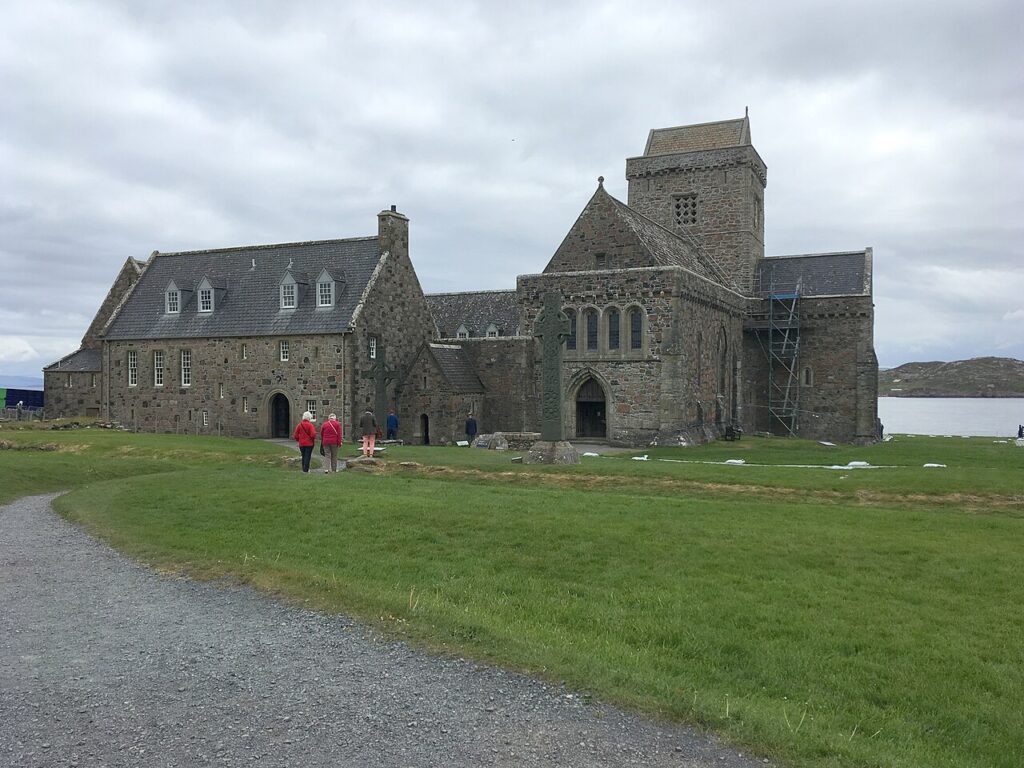
Image above: St Mary’s Abbey, Iona, standing on the site of the monastic community Columba founded in 563.
Columba was born around 521 at Gartan in County Donegal, into the Cenél Conaill, a branch of the northern Uí Néill dynasty powerful enough that he was, by birth, eligible for kingship himself. He was not destined for a monastery by poverty or obscurity; he entered religious life from a position of real political standing, and that standing shaped nearly everything that followed, for better and for worse. Tradition holds that his birth name was Crimthann, “fox,” and that the name Colum Cille — “dove of the church” — was given to him later for the piety observed in him as a boy. Whether or not the etymology is exactly as the hagiographers tell it, the two images, the fox and the dove, sit oddly well together across the record of his life.
Evidence tier: PROVEN for Columba’s birth date, region, and dynastic standing, corroborated by Adomnán’s Vita Columbae, written by the ninth abbot of Iona around the year 700 and drawing on earlier written and oral sources close to Columba’s own lifetime — one of the most substantial and carefully constructed hagiographic texts to survive from the early medieval period anywhere in Europe.
Formation Across Two Kingdoms
Columba’s education tracked across several of early Ireland’s most significant monastic schools. He entered Movilla Abbey at Newtownards, on the shore of Strangford Lough in County Down, under Finnian of Movilla, where he was ordained deacon. He went on to study under the bard Gemman, which grounded him directly in the pre-Christian tradition of the filid, Ireland’s professional poets and jurists — an unusual credential for a churchman and one that likely shaped the value early Irish Christianity placed on native learning rather than simply displacing it. He then studied at Clonard Abbey in County Meath under a second Finnian, where he was ordained priest, training alongside future monastic founders including Ciarán of Clonmacnoise and Comgall, who would go on to found Bangor Abbey.
Around 545 or 546, Columba founded a monastery at Doire Calgaich — “the oak grove,” now Derry — at the southern edge of the Inishowen peninsula. He went on to found further houses at Durrow in County Offaly and elsewhere, but the tradition consistently holds that Derry remained the foundation closest to him personally.
The Battle and the Exile
The best-known episode of Columba’s Irish career is also its least reliably attested. The story, in its familiar form, holds that Columba secretly copied a psalter belonging to Finnian of Movilla; that Finnian demanded the copy; that the High King Diarmait mac Cerbaill arbitrated with the judgment “to every cow belongs her calf, therefore to every book belongs its copy”; and that Columba’s refusal to accept the ruling, combined with a separate grievance over the killing of a man under his protection, led to the Battle of Cúl Dreimhne in County Sligo around 560 or 561, in which forces aligned with Columba’s Cenél Conaill defeated the High King’s army.
Evidence tier: LEGEND, not evidence. This version of events was first recorded in detail by Manus O’Donnell in the 1530s, nearly a thousand years after the events it describes, and the earliest surviving sources for the battle itself do not mention a book dispute at all. What the earlier record does support is that the battle happened, that it pitted the northern Uí Néill against the High King’s forces, and that Columba’s departure from Ireland followed it closely. The political reading — a dynastic and territorial conflict between the northern and southern branches of the Uí Néill, dressed in later centuries with the more memorable story of a stolen manuscript — is the interpretation most historians of the period now favour, though it remains an interpretation rather than a documented fact.
What is well attested is the consequence: Columba was brought before a synod of clerics facing excommunication, and the sentence was commuted, through the intervention of Brendan of Birr, to exile. In 563, Columba sailed from Ireland to the small Hebridean island of Iona with twelve companions. The Iona chronicle tradition records the event precisely: in the second year after Cúl Dreimhne, in his forty-second year, he sailed away “wishing to be a pilgrim for Christ.” Iona itself lay within the territory of Dál Riata, a Gaelic kingdom straddling the sea between north-east Ireland and western Scotland, and Columba’s own kinsman, Conall mac Comgaill, King of Dál Riata, granted him the island. He was not, in any meaningful sense, leaving his own people; Gaelic-speaking Ulster communities had inhabited that stretch of the Scottish coast for two centuries already. He was moving within a familiar world, not into an alien one.
Iona
From that small island, Columba built the centre of a monastic confederation that would outlast him by centuries. He is credited with converting Bridei, king of the Picts, and with establishing churches across the Hebrides. Every daughter house Iona founded on either side of the Irish Sea remained under the ecclesiastical headship of Iona’s abbot, and for generations those abbots were drawn overwhelmingly from Columba’s own kin among the Cenél Conaill — a striking fusion of monastic and dynastic authority that helped hold the confederation together long after its founder’s death.
Columba died on Iona on 9 June 597, having spent the final thirty-four years of his life building an institution from a small island his own royal kinsman had granted him in the aftermath of disgrace.
Evidence tier: PROVEN for the 597 death date, the Dál Riata land grant, and the abbacy’s continuation within Columba’s kin group, all independently corroborated across Adomnán’s Vita Columbae and the Iona chronicle tradition underlying the Irish annals.
What Iona Made Possible
The most consequential part of Columba’s legacy happened after his death, and it reached far beyond Scotland. In the 630s, Oswald, an exiled prince of Northumbria, had spent years among the Gaelic community at Iona, learning both the Irish language and the Christian faith. When Oswald won the Northumbrian throne after the Battle of Heavenfield in 634, he turned to his friends at Iona rather than to the Roman mission established at Canterbury. A monk named Aidan was sent, established his see at Lindisfarne — deliberately chosen to echo Iona itself — and from there evangelised the whole of Northumbria, training the men who would go on to convert further Anglo-Saxon kingdoms. Bede, writing roughly a century later from within the Roman tradition that would eventually supersede Iona’s own dating of Easter, still praised Aidan without reservation for labouring “to practise the works of faith, piety, and love.” The Northumbrian golden age that followed — the Lindisfarne Gospels, the scholarship of Bede himself, the monastic culture of Jarrow and Wearmouth — rested on foundations that trace directly back to the island Columba reached in exile.
Evidence tier: PROVEN for the Iona-to-Lindisfarne mission and its Northumbrian consequences, attested at length and in detail by Bede’s Ecclesiastical History of the English People, a source written within living memory of the events it describes and by an author with no particular reason to overstate an Irish contribution to English Christianity that his own church had since moved away from doctrinally.
What the record permits, read carefully and without the embellishments later centuries added to it, is a genuinely remarkable story on its own terms: a Donegal prince, eligible for a throne he never took, brought down by a battle whose real causes are more political than the legend allows, sailed into exile with twelve companions and built, on a small island off the Scottish coast, an institution that outlived him by generations and that carried Christianity into Pictish Scotland and, indirectly but traceably, into Northumbria and the making of English Christian culture. The dove and the fox were both real. So, in the end, was what he built.
Sources: Adomnán of Iona, Vita Columbae (Life of St Columba), c.700; Bede, Historia ecclesiastica gentis Anglorum; the Irish annals (Annals of Ulster and Annals of Tigernach) for the dating of Cúl Dreimhne and Columba’s death; Richard Sharpe’s introduction and notes to the Penguin Classics edition of Adomnán’s Life of St Columba, for the critical assessment of the psalter-dispute legend and its late attestation by Manus O’Donnell.
Featured image: St Mary’s Abbey, Iona. Photograph by M J Richardson, Creative Commons Attribution-ShareAlike 2.0, via Wikimedia Commons / Geograph.