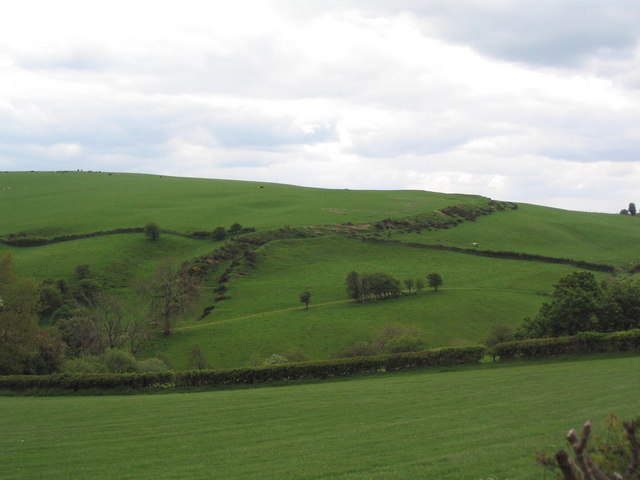
Image above: Offa’s Dyke on Llanfair Hill, on the Welsh border — one of the largest linear earthworks in Europe, and the clearest physical trace Offa left behind.
For nearly forty years, from 757 to 796, Offa ruled Mercia, and for a substantial stretch of that reign he was, in effect, the most powerful king in Britain south of the Humber. He did not inherit that position; he took it after a civil war following the assassination of his predecessor Æthelbald, and he spent the decades that followed converting military dominance into something more durable: a system. That system is the reason Offa is remembered at all beyond a list of regnal dates, and it is worth setting out plainly what he actually built, because the record supports a genuinely striking case for one of early medieval Europe’s most capable rulers.
Evidence tier: PROVEN for the broad shape of Offa’s reign and reach — corroborated across the Anglo-Saxon Chronicle, charter evidence, and Frankish correspondence, notably Offa’s documented exchanges with Charlemagne, who addressed him as a fellow monarch of consequence and negotiated a (temporarily suspended) trade agreement with him around 796. Few Anglo-Saxon kings before Alfred left that kind of continental paper trail.
The Coinage State
Offa’s most consequential and least visually dramatic achievement was monetary. He introduced a broad, thin silver penny that replaced the older, cruder sceattas in circulation, and he enforced it as something close to a royal monopoly: a standardised currency, minted under royal authority, moving through markets his administration also controlled. This was not decoration. A single trusted currency, accepted without haggling over weight and purity at every transaction, is a form of jurisdiction made tangible — proof, carried in the pocket of every trader from Kent to the Midlands, that Offa’s authority reached wherever his coin was spent.
He went further still. A small number of surviving gold coins bear his name struck in imitation of the Abbasid dinar of Caliph al-Mansur, complete with Arabic script, and — remarkably — with “OFFA REX” stamped into the design in place of the Islamic religious inscription the original coin carried. Evidence tier: PROVEN that the coin exists (it survives in the British Museum) and that it demonstrates direct awareness of, and engagement with, Mediterranean and Islamic trade networks reaching Anglo-Saxon England. Evidence tier: INFERENCE as to precisely why it was struck — whether as coinable currency for trade with Muslim Spain, as a diplomatic curiosity, or as a display of sophistication — since no contemporary Mercian document explains the mint’s intent.
The Dyke
Then there is the earthwork that still carries his name. Offa’s Dyke runs, in surviving and documented sections, for roughly 150 miles along the England–Wales border, in places reaching eight metres from ditch bottom to bank top. It was not a continuous defensive wall in the Roman sense — much of it uses natural terrain, and archaeological work has shown gaps and regional variation — but as a statement of where Mercian authority ended and did not end, it is unambiguous. Asser, King Alfred’s biographer writing roughly a century later, attributed a dyke “from sea to sea” to Offa, and while modern archaeology treats the full continuous-frontier claim with appropriate caution, the excavated sections that can be dated to the later eighth century are substantial, deliberate, and consistent with a king asserting a border rather than merely reacting to one.
Evidence tier: PROVEN for the existence, scale, and approximate eighth-century dating of the principal dyke sections. Evidence tier: DISPUTED for Asser’s claim of a single continuous sea-to-sea structure, which current archaeological consensus regards as an overstatement of what the ground actually shows.
The Church as Instrument
Offa’s reach extended into ecclesiastical politics too. In 787 he secured papal approval to elevate Lichfield to an archbishopric, splitting the province from Canterbury’s authority and placing a Mercian-controlled archbishop at the head of it — a direct assertion of Mercian primacy over the English church that Canterbury had held uncontested for a century. The arrangement did not survive him; the archbishopric was dismantled by 803, within seven years of his death, and Canterbury’s authority was restored. It stands as one of the clearest single data points for the argument at the centre of Offa’s story: he built structures that depended entirely on his personal authority to hold them in place, and that could be, and were, unwound the moment that authority was gone.
The Collapse
Offa spent his final years forcing the co-kingship of his son Ecgfrith, having him consecrated and crowned during his own lifetime in an explicit attempt to guarantee a smooth succession — the kind of dynastic engineering more commonly associated with Continental monarchies of the period. It did not work. Ecgfrith succeeded his father in July 796 and was dead by December of the same year, after a reign of around 141 days. The Anglo-Saxon Chronicle offers no cause of death; a letter from Alcuin of York, writing shortly afterward, described the House of Mercia as having been struck down for the sins of the father, which is theology rather than diagnosis, but it registers just how quickly contemporaries recognised the collapse as remarkable.
Coenwulf, a more distant relative, took the throne after Ecgfrith and held Mercian hegemony together through sheer persistence for roughly twenty-five years, but the foundation had shifted. By 825, at the Battle of Ellendun, Mercia’s subject kingdoms defected wholesale to Wessex under Ecgberht, and the hegemony Offa had spent nearly four decades constructing was gone within a single generation of his death.
Evidence tier: PROVEN for Ecgfrith’s brief reign and the 825 collapse at Ellendun, both independently attested in the Chronicle. Evidence tier: INFERENCE for the causal claim that the collapse happened because Offa built personal rather than institutional power — this is the most persuasive reading of the sequence of events, and it is the reading most historians of the period favour, but it remains an interpretation of a pattern rather than a fact stated outright in any single source.
What the record permits is this: a king who inherited a fractured kingdom through civil war built, within his own lifetime, a currency trusted across his realm, a border marked in earth still walkable today, a church province answerable to him rather than Canterbury, and a diplomatic standing that made Charlemagne treat him as an equal. Almost none of it outlived him by more than a generation. Offa’s genius was real, and so was its limit: he built power that scaled magnificently and did not ask, seriously enough, what would happen to it the day he was no longer there to hold it together. The dyke is still there. The kingdom is not.
Sources: Anglo-Saxon Chronicle (multiple manuscript recensions); Asser, Life of King Alfred; correspondence of Alcuin of York; British Museum catalogue entry for the Offa gold dinar; Cyril Hart and other standard surveys of Offa’s Dyke archaeology; Simon Keynes, “Offa” in the Blackwell Encyclopaedia of Anglo-Saxon England.
Featured image: Offa’s Dyke on Llanfair Hill. Photograph by Tim Heaton, Creative Commons Attribution-ShareAlike 2.0, via Wikimedia Commons / Geograph.