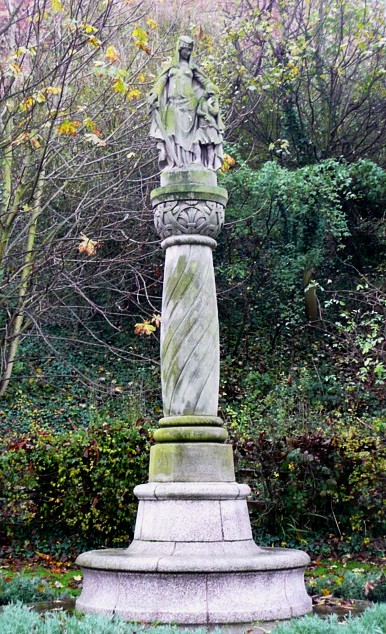
Image above: the 1913 monument to Æthelflæd at Tamworth Castle, showing her with her nephew Æthelstan, whom she raised in her own court.
Æthelflæd was born around 878, in the middle of the Somerset marshes, during the darkest stretch of her father Alfred’s war against the Great Heathen Army — a childhood spent, quite literally, in the survival of the West Saxon kingdom. She married Æthelred, ealdorman and then Lord of the Mercians, sometime in the 880s, and the surviving charter evidence shows something unusual for the period: she is named alongside her husband as a joint authority from early in the marriage, not merely as consort. When Æthelred’s health failed in the 900s and he died in 911, Æthelflæd did not step aside for a male regent. She took the title “Lady of the Mercians” and ruled Mercia in her own name for the following seven years.
Evidence tier: PROVEN for the joint rule and the 911 succession, both attested in charters and the Mercian Register, a distinct strand of annals embedded within some versions of the Anglo-Saxon Chronicle that appears to derive specifically from a Mercian source sympathetic to Æthelflæd’s rule.
The Burh Network
Alfred had pioneered the burh — a fortified settlement, garrisoned and provisioned, designed so that no part of Wessex lay more than a day’s march from defensible walls. It was, in his hands, primarily defensive: a system for surviving Viking raids. Æthelflæd took the same tool and turned it into something closer to an instrument of conquest. Between roughly 907 and 915, she is credited with the construction or refortification of at least ten documented strongholds across Mercia: Chester in 907, Bridgnorth and Tamworth in 912, Stafford in 913, Eddisbury, Warwick and Chirbury in 914, and Runcorn in 915, among others recorded with less precise dating. Each fortress closed a gap in Mercia’s exposure to Norse raiding from the Irish Sea and the Danelaw, and taken together they formed a defensive spine that also functioned, deliberately, as a network of forward positions for offensive campaigns.
Evidence tier: PROVEN for the burh construction dates, which are recorded with unusual specificity in the Mercian Register — a level of chronological precision not typically afforded to Anglo-Saxon building projects of this period, which is itself suggestive of how closely contemporaries were tracking her campaign.
Derby, and What the Record Won’t Soften
In 917, Æthelflæd led a campaign against the Viking-held town of Derby, one of the Five Boroughs of the Danelaw, coordinating her movement with her brother Edward the Elder’s simultaneous operations further south and east. The siege was not bloodless, and the Mercian Register does not pretend otherwise: it records that “four of her thegns, who were dear to her, were killed within the gates.” That single line is one of the few moments in the entire Mercian Register where personal grief breaks through the register’s otherwise clipped, administrative tone, and it is worth taking seriously as evidence of how the campaign was actually experienced, not merely how it was won. Derby fell. The following year, 918, Leicester surrendered to her without a fight — a decision the record does not explain in detail, but which historians reasonably read as the town’s leadership drawing the obvious conclusion from what had happened at Derby the year before.
The Submission That Never Was
In the spring of 918, the Norse leadership of York — a Viking stronghold since the ninth century, and the single most significant prize remaining in the Danelaw — offered Æthelflæd their submission and loyalty. It would have been the culminating achievement of her reign: the delivery, without a battle, of the north’s most important city. She died at Tamworth on 12 June 918, eight weeks before that submission could be formalised. Evidence tier: PROVEN that the offer was made and that she died before it was concluded, both recorded in near-contemporary annals. Evidence tier: INFERENCE — reasonable, widely shared among historians of the period, but still interpretation rather than fact — that had she lived even a few months longer, York’s submission would likely have been secured under her rule rather than falling to conquest a decade later under Æthelstan in 927.
What Survived Her
Æthelflæd was succeeded, briefly, by her daughter Ælfwynn, who is recorded ruling for perhaps six months before Edward the Elder moved to absorb Mercia directly into the West Saxon crown, removing Ælfwynn from power. On the narrow question of dynastic succession, then, Æthelflæd’s line did not hold. But the institutions did. The burhs she built did not disappear when her personal authority ended; they became, over the following generation, the administrative backbone of the English shire system — Warwickshire, Staffordshire, Cheshire, and others, each organised around a fortress she had ordered built. Where Offa’s hegemony had depended entirely on Offa and collapsed within a generation of his death, Æthelflæd’s did not, because she had built something that did not require her continued presence to function.
Evidence tier: PROVEN for Ælfwynn’s brief rule and Edward’s annexation of Mercia. Evidence tier: INFERENCE for the direct line drawn between the specific burhs Æthelflæd founded and the later shire boundaries — the correspondence is well attested in general terms by historians of Anglo-Saxon administrative geography, though the precise mechanics of how each individual burh became each individual shire seat are not uniformly documented site by site.
Her nephew Æthelstan, raised largely within her Mercian court, would go on to complete what she began: the conquest of York in 927 and, ultimately, the first unified kingdom of England. He owed her more than sentiment. He owed her the burhs, the administrative habits, and the Mercian noble networks that made his own consolidation possible. Alfred stopped the Vikings from ending Wessex. Æthelflæd built the infrastructure that outlasted her. Between the two of them stands one of the more genuinely remarkable reigns in early English history — not remembered as widely as it should be, and supported, where it counts, by a chronicle record that treats her with a precision and a grief it rarely extends to Anglo-Saxon rulers of either sex.
Sources: The Mercian Register (embedded within the “C,” “B,” and “D” recensions of the Anglo-Saxon Chronicle); Anglo-Saxon Chronicle, main text; Æthelweard’s Chronicle; Sarah Foot, “Æthelflæd, Lady of the Mercians,” in Æthelstan Papers; Ian Walker, Mercia and the Making of England; PMSA public sculpture database, entry for the Tamworth monument.
Featured image: the Æthelflæd Monument, Tamworth Castle grounds, showing Æthelflæd with her nephew Æthelstan. Designed by H. C. Mitchell, sculpted by E. G. Bramwell, erected 1913. Photograph by Humphrey Bolton, Creative Commons Attribution-ShareAlike 2.0, via Wikimedia Commons / Geograph.