Evidence classified per the TBAR framework: PROVEN / PROBABLE / POSSIBLE / UNSUPPORTED / CONTRADICTED.
Sir William Walworth is remembered almost entirely for one moment: striking down Wat Tyler at Smithfield on 15 June 1381. The administrative record shows a far more embedded figure than that single image suggests — a Fishmonger who rose through three decades of civic office to become one of the Crown’s principal creditors, and who was already, before the revolt reached London, a central figure in the city’s factional politics. The Smithfield killing itself is better attested, and more contested in its details, than either the heroic tradition or the modern shorthand — “Walworth killed Tyler” — allows.
A career in the record: PROVEN
Walworth’s civic career is documented in unbroken detail in the City of London’s own Letter-Books, calendared by Reginald Sharpe and confirmed independently in the Dictionary of National Biography.
- Apprenticed to the Fishmonger and Alderman John Lovekyn; succeeded him as Alderman of Bridge Ward on 11 November 1368.
- Elected Sheriff of London on 21 September 1370; contributed £200 to a city loan to Edward III that same year.
- Elected Mayor in 1374–75. During this term he ordered the city gates’ porters sworn to exclude lepers, and limited the length of tavern alestakes.
- MP for the City of London in 1371, 1376 (the Good Parliament), 1377, and 1383.
- Elected Mayor a second time in 1380–81 — meaning he held the office throughout the revolt itself.
- In January 1381, appointed “English Alderman” of the Hanseatic merchants at the Steelyard. His own house stood on the site later occupied by Fishmongers’ Hall, close to the Hanse’s London base.
Financier to the Crown: PROVEN
On 18 September 1377, Nicholas Brembre, Walworth, John Philipot and John Hadley — a syndicate of London’s wealthiest merchants — advanced £10,000 to the newly crowned Richard II, secured against customs revenue and pledged royal jewels. This is recorded in the Fine Rolls and corroborated across the Dictionary of National Biography, Sharpe’s Calendar, and modern Chaucer scholarship (the same syndicate whose customs dealings the poet Geoffrey Chaucer, as Comptroller of the Wool Custom, was appointed to audit from 1374).
Later that year, Walworth and Philipot were appointed Treasurers of the two-tenths-and-fifteenths war subsidy granted by Parliament — direct control over the Crown’s war finances. John of Gaunt had them removed from this post at the Gloucester Parliament of 1378, though the City’s own records note “no fault could be found with the way they had fulfilled their duties.”
Tier: PROVEN for the loan and treasurership. PROBABLE that this financial embeddedness shaped Walworth’s later hard line against the revolt. UNSUPPORTED that it was his specific personal motive for attacking Tyler — that inference should not be presented as established fact.
The city’s defence, and its betrayal from within
On the night of 12 June, as the rebel host gathered south of the river, Walworth raised London Bridge’s drawbridge, closed the city gates, and ordered the aldermen to guard their wards. He sent three aldermen to warn the rebels off; two delivered the message, a third made secret contact with Tyler’s camp instead.
The defence was undermined further still: Alderman Walter Sibley prevented the bridge from being properly held, and Alderman William Tonge opened Aldgate to the Essex contingent — both against Walworth’s direct orders. This is documented in the Sheriffs’ Inquest of November 1382, printed by Réville and used extensively by Oman. Sibley and Tonge were tried repeatedly between 1383 and 1384 and eventually discharged for want of witnesses — a marked contrast with the summary justice Walworth would soon mete out to captured rebels.
Smithfield, 15 June: the fullest account
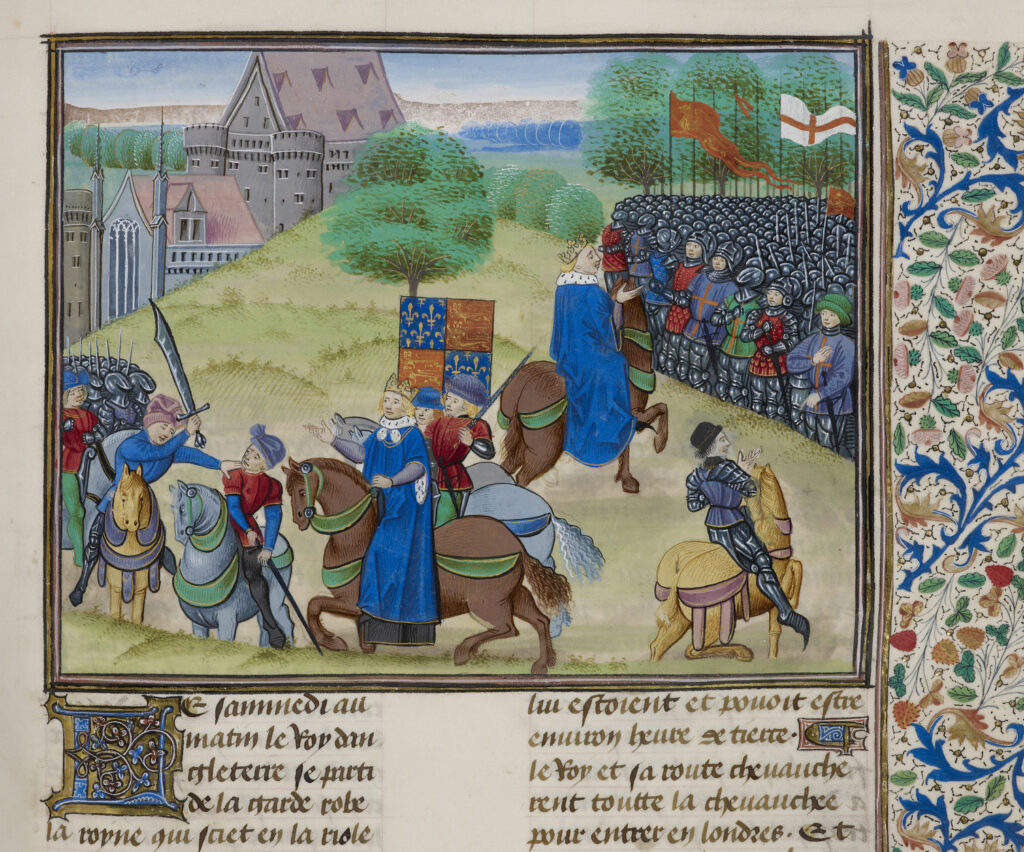
The most detailed near-contemporary narrative, the Anglo-Norman Anonimalle Chronicle, gives this sequence, corroborated in outline by the City’s own Letter-Book H: Tyler, in confrontation with the King, drew his dagger against a royal valet who had called him a thief. Walworth stepped in to arrest Tyler for this violence in the King’s presence. Tyler stabbed at Walworth’s stomach; a coat of mail worn beneath his mayoral robes saved him. Walworth struck Tyler in the neck, then the head. A member of the King’s household then ran Tyler through with a sword. Tyler rode roughly eighty paces before falling. Walworth returned to the city, raised a relief force, and — finding Tyler had been carried, still living, to St Bartholomew’s Hospital — had him brought back to Smithfield and beheaded there.
The City’s own civic record of the same day (Letter-Book H, translated in Riley’s Memorials of London) gives a markedly shorter, sole-hero version:
“…by the hand of the most renowned man, Sir William Walworthe, the then Mayor… most manfully, by himself, rushed upon the captain of the said multitude… first wounded him in the neck with his sword, and then hurled him from his horse, mortally pierced in the breast.”
No valet. No second attacker. No mention that Tyler struck first. This is not an oversight — the same civic record is also entirely silent about the Sibley and Tonge betrayals. It is an institution recording the version of events that reflects best on its own leadership.
Even the knighthoods that followed hint at the gap between the two versions: only four men were dubbed that day — Walworth, Brembre, Philpot, and Robert Launde. No squire was honoured alongside them, though someone plainly delivered the fatal blow. Walworth’s own reward is recorded specifically as “£100 in land” — a one-time grant, not an ongoing annuity.
Tier: PROVEN that Walworth struck Tyler and later had him beheaded. CONTRADICTED that he killed him alone. PROBABLE, not proven, as to which specific blow was fatal.
An open question: who struck the second blow?
Every source agrees a member of the royal household delivered further wounds. The name is genuinely unsettled, not merely a spelling variant. Charles Oman, across two of his own works, gives “John Standwick” (also spelled Standyche). Most popular modern accounts instead give “Ralph Standish.” No source examined in this research has produced and quoted the original Knighton or Froissart text that would settle the discrepancy either way. This should remain flagged as an open question — not resolved in either direction — until the original chronicle texts are examined directly.
The repression that followed
That same night, Richard II granted Walworth — with Robert Knolles, Brembre, Philpot, and Robert Launde — a commission empowering them to proceed against rebels “by other ways and means,” including beheading and mutilation, without ordinary jury process. Under this authority Walworth presided over several executions, including Jack Straw, whom he reportedly persuaded into a death-cell “confession” in exchange for masses said for his soul — a confession even Oman treats with explicit scepticism — and John Starling, an Essex man who reportedly confessed to killing Archbishop Sudbury. That confession is attested only in the Walsingham tradition, with no independent corroboration located anywhere in this research, and should never be presented as an established fact.
Notably, Sibley and Tonge — the aldermen who had betrayed the city’s own defence — were imprisoned rather than executed, and discharged by 1384.
Political alignment: an unresolved contradiction
The Dictionary of National Biography‘s own entry on Walworth is internally inconsistent. One passage states: “The city was now divided into two parties — one headed by Walworth and John de Northampton… which strongly supported the Duke of Lancaster; the other with Philipot and Brembre at its head, which as strongly opposed him.” Yet elsewhere, DNB and most modern accounts group Walworth with Philipot and Brembre as the anti-Gaunt faction. This should not be flattened into a fixed “Walworth hated Gaunt” narrative; the safest formulation is that he belonged to a mercantile-civic faction whose relationship with Gaunt shifted according to circumstance.
Death and burial
Walworth died in 1385 and was buried at St Michael’s, Crooked Lane, in a chantry chapel he had endowed under a royal licence of 1380 — both facts confirmed directly against the DNB entry. The monument was destroyed during the Reformation and again in the Great Fire; the church itself was demolished in 1831. No contemporary parish burial register survives, so the exact day and month of death rest on will and probate records rather than an independent burial entry.
The heraldic legend: fully resolved
A persistent tradition, first documented in Holinshed’s Chronicles (1577) and later inscribed beneath a statue of Walworth at Fishmongers’ Hall, holds that Richard II added a dagger to the City of London’s coat of arms to commemorate Walworth’s killing of Tyler. This is demonstrably false and precisely datable: the City’s arms — a sword representing the martyrdom of St Paul, the city’s patron saint — were already in use on the Lord Mayor’s own seal from 17 April 1381, ordered under Walworth’s own mayoralty, two months before Smithfield.
Tier: CONTRADICTED.
For the King’s Bench record naming the Tower assault’s actual chief leader — not a man — see TBA-011: The Tower, 1381.
What remains
Strip away the statue, the verse, and the tidy single-blow version, and what remains is more complicated, and more worth telling: a wealthy, deeply embedded civic operator who organised a defence his own colleagues sabotaged, who wounded but did not single-handedly kill the rebellion’s leader, who extracted a confession from a condemned man under promise of prayers for his soul, and who was mythologised into a solitary hero within two centuries of his death.
Open items for further research: the identity of Tyler’s second attacker; independent corroboration for Starling’s confession; the exact text of the Rotuli Parliamentorum indemnity; and direct examination of Prescott’s 1984 thesis on the judicial records of the rising.