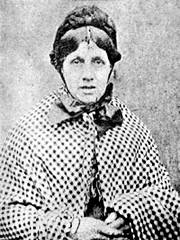
Image above: Mary Ann Cotton, circa 1870. Contemporary photograph, public domain, via Wikimedia Commons.
On 24 March 1873, Mary Ann Cotton was hanged at Durham County Gaol for the murder of her seven-year-old stepson. By then, newspapers had already spent five months compiling a much longer list: husbands, a lover, her own mother, a string of children and stepchildren, stretching back twenty years. The court never tried a single one of those other deaths.
The Death of Charles Edward Cotton
On 12 July 1872, seven-year-old Charles Edward Cotton died at his family’s home in West Auckland, County Durham. Days earlier, his stepmother, Mary Ann Cotton, had asked Thomas Riley, a parish official, to have the boy admitted to the workhouse. Riley refused. According to Riley’s own later account, Cotton told him she wouldn’t be troubled long, that the boy would “go like all the rest of the Cottons.” Contemporary testimony described Charles Edward as previously healthy.
Evidence tier: PROBABLE. This sequence is consistent across multiple secondary sources drawing on contemporary press and trial reporting. No primary Durham Assizes transcript has been independently retrieved in this research to confirm Riley’s exact wording under oath.
The Inquest and the Chemist
An inquest first returned a verdict of natural causes. Riley, already suspicious, pressed for further inquiry. Dr. William Byers Kilburn, who had attended the boy, retained samples from the body and sent them to Dr. Thomas Scattergood, a forensic chemist in Leeds. Scattergood found solid arsenic trioxide in the child’s stomach.
Three more bodies from the same household were exhumed that year: Frederick Cotton Jr., Robert Robson Cotton, and Joseph Nattrass, Cotton’s former lover and lodger. Arsenic turned up in all three, though only Charles Edward’s death was ever brought to trial.
Evidence tier: PROBABLE. Corroborated across Capital Punishment UK’s case account, trial-evidence transcriptions hosted at maryanncotton.co.uk, and standard reference summaries. Kilburn and Scattergood’s own casebook, and the original inquest record, have not been directly examined in this research.
The Trial
The trial opened at Durham Assizes on 5 March 1873, on a single charge: the murder of Charles Edward. Cotton’s defence, led by Thomas Campbell Foster, argued for an innocent source for the arsenic, principally the soft soap the family used against bedbugs, and, in some accounts, the wallpaper.
The wallpaper claim does not resolve cleanly. One account has Foster arguing in court that the arsenic came from green, arsenical wallpaper in the house. Another has Kilburn testifying under cross-examination that the wallpaper was not green at all, and that even if it had been, he did not think it could have caused death. Both cannot be right, and the underlying trial record that would settle which is accurate has not been directly inspected in this research.
Evidence tier: CONTRADICTED. Two available secondary accounts disagree on a specific, checkable point of trial testimony. Both versions are left standing here rather than arbitrated.
The jury convicted Cotton of the single count, Charles Edward’s murder, after a deliberation sources put at somewhere between roughly an hour and ninety minutes. A week after the verdict, with the question already settled, Scattergood wrote up his rejection of the defence’s theories anyway: wallpaper dust, he concluded, “would not account for the presence of solid arsenic trioxide in the stomach,” and soft soap “could not possibly have been powdered any more than butter could have been powdered.”
Evidence tier: POSSIBLE. These quotations are drawn from a modern trial-evidence transcription rather than a primary casebook or court record examined directly here. They should be treated as probably accurate but not independently confirmed.
Cotton was hanged at Durham County Gaol on 24 March 1873. The executioner was William Calcraft.
Evidence tier: PROBABLE.
The Number That Preceded the Verdict
Before the trial had even opened, the case had already outgrown Charles Edward’s death. By around October 1872, five months before the verdict, local and national papers were compiling a much longer account of Cotton’s life: three husbands, a lover, her mother, a string of children and stepchildren, across two decades. That list is the likely origin of the number still repeated today — up to twenty-one victims.
What can be said with more confidence than that figure itself is this: the expanded body-count narrative was circulating in print before a jury had returned any verdict at all, and no court ever tested the deaths beyond Charles Edward’s and the three exhumed alongside his case.
Evidence tier: PROBABLE. The October 1872 press compilation is referenced by a Guardian archive listing that remains behind a paywall in this research, so its exact date, page and wording have not been directly confirmed. The broader point — that the twenty-one figure predates the verdict — is corroborated by multiple secondary sources.
The System
The households Cotton moved through were insured. William Mowbray’s life, and the lives of his and Cotton’s children, were reportedly covered through the British and Prudential Insurance office: a reported thirty-five pounds paid out on his death, and smaller sums on two of the children. Frederick Cotton and his sons were said to be insured too.
Evidence tier: POSSIBLE. These figures come from a single secondary source and have not been checked against original insurance or parish paperwork.
What the Trial Did Not Do
Cotton was tried and convicted for one death. She was never tried for the deaths of Nattrass, Frederick Cotton Jr., or Robert, despite arsenic being found in all three. At least one account states that Kilburn and Scattergood described those three arsenic findings to the jury during the Charles Edward trial itself, but being told about a pattern is not a verdict on it. The jury was asked to decide, and did decide, only the single charge in front of it.
Arsenic in a body establishes that arsenic was present. It does not, by itself, identify who administered it, prove the act was deliberate, or establish murder. Each of the other three deaths would have needed its own evidential case, built and tested separately. None of the three ever received one.
A direct search of the National Archives’ Discovery catalogue, run against both the Durham depositions series (DURH) and the national assize series (ASSI) for a Durham trial in 1873, returns nothing under Cotton’s name. That is consistent with records catalogued by sitting or date rather than by defendant, not with the records being missing.
Evidence tier: PROVEN, for the search itself and its null result, run directly in this research. What that null result means about the underlying records remains unresolved.
What can actually be shown is narrower than what usually gets said about this case. One murder, tried and proven by the standards of an 1873 jury. Arsenic detected in four bodies. A defence theory a forensic chemist took seriously enough to test, and rejected, after the verdict had already made the test moot. Everything past that line is suspicion the jury heard about but was never asked to rule on — not because the suspicion was unreasonable, but because one conviction was already enough to end the only question the court had actually been empanelled to answer.
Cotton was not the first Englishwoman hanged for poisoning within a family. Mary Bateman was hanged at York in 1809, for a laced pudding. Catherine Wilson was hanged at Newgate in 1862, convicted of a single poisoning and suspected, at the time, of six or seven more. Wilson’s case has almost exactly Cotton’s shape — one conviction, a wider suspicion nobody tried. That symmetry rarely survives into the popular retelling of either woman.
Sources: Capital Punishment UK, “Mary Ann Cotton: The West Auckland Poisonings”; geriwalton.com, “Mary Ann Cotton: Female Serial Killer of the 1800s”; maryanncotton.co.uk, trial-evidence transcriptions; Wikipedia, “Mary Ann Cotton,” “Mary Bateman,” “Catherine Wilson”; legislation.gov.uk, Offences Against the Person Act 1861; The National Archives, Discovery catalogue, direct DURH and ASSI series searches. This piece has not yet been through a full five-pass primary-source verification per the TBAR Production & QC Protocol — treat quotations and figures marked POSSIBLE above accordingly.
Featured image: Mary Ann Cotton, circa 1870, public domain, via Wikimedia Commons.