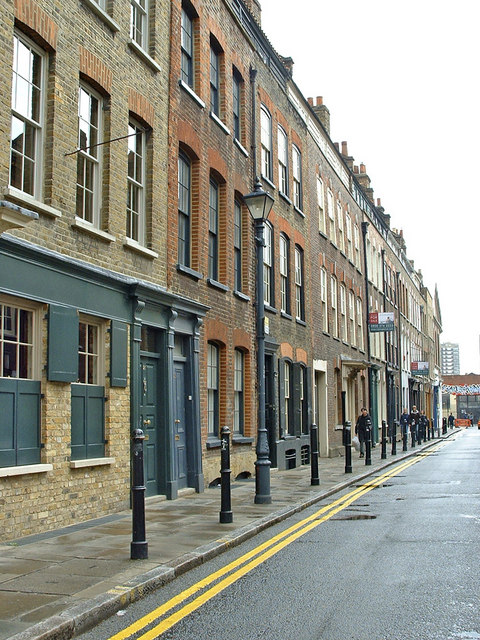
Image above: Fournier Street, Spitalfields — original Huguenot dwelling houses, their glazed top storeys built to light the silk workers’ looms.
The refuge did not begin in 1685, though that is the date everyone remembers. It began more than a century earlier, in the 1550s, when the first communities of French-speaking Protestants started gathering in London under a name the English gave them almost as an afterthought: the Church of Foreigners. In 1550, Edward VI granted that church formal recognition. It was a small, early signal of something that would happen again and again over the following two hundred years: a Protestant kingdom taking in refugees from a Catholic one, and being changed by the deal.
The pattern repeated in 1572, when the St Bartholomew’s Day massacre in Paris, in which Catholic mobs killed thousands of Huguenots (French Protestants, named for a disputed etymology involving the Swiss reformer Besançon Hugues) over several days, sent a fresh wave of refugees across the Channel. Numbers in London fluctuated with the persecution back home: an estimated 5,300 refugees in the early 1570s, dropping to 1,500 as some returned or moved on, then climbing back toward 3,500 by the early seventeenth century. It was a refuge that opened and narrowed with the political weather in France, not a single event but a current that ran for generations before the flood everyone remembers.
That flood came on 18 October 1685, when Louis XIV signed the Edict of Fontainebleau, revoking the Edict of Nantes that had guaranteed French Protestants freedom of worship since 1598. Huguenot churches were to be destroyed, Protestant schools closed, and children raised Catholic by law. An estimated 200,000 Huguenots left France entirely rather than convert or comply, scattering across Prussia, the Dutch Republic, Switzerland, the American colonies and Britain. England, by the most widely cited estimates, received somewhere between 40,000 and 50,000 of them between 1685 and the early 1700s, with roughly half settling in London itself. By 1700, Huguenots made up something in the region of five per cent of the city’s population, worshipping in at least nine separate churches in Spitalfields alone.
Evidence tier: PROVEN, for the scale of the migration and its rough demographic footprint. The precise refugee count is necessarily an estimate, drawn from parish and naturalisation records rather than a single contemporary census, and historians’ figures vary by several thousand either way. What is not in dispute is that England absorbed, in a single generation, a foreign-speaking religious minority equivalent to a significant fraction of its capital city, and did so without the sustained, organised violence that met other refugee movements in other centuries.
Reception was not automatic goodwill so much as a series of specific royal and civic decisions, each traceable to a name and a date. Elizabeth I had granted the earliest arrivals asylum and the right to worship. Charles II, after the Restoration, eased their path to settlement and naturalisation on equal tax terms with English subjects. William III, a Protestant king who had his own reasons to welcome French Protestant soldiers and financiers, actively protected the refuge population through the 1690s. Queen Anne, in 1709, extended a general naturalisation act that gave many Huguenots full citizenship rights. The refugees, in turn, built their own support infrastructure rather than relying solely on the Crown: an alms system known as La Soupe, and La Providence, a dedicated hospital founded in 1718 to care for elderly and sick members of the community. It was, in the language of a later century, a self-funding integration.
What the refugees built once settled is where the record becomes genuinely startling.
Silk, Silver and Streets That Still Remember
In Spitalfields, in London’s East End, Huguenot silk weavers turned a marshy suburb into the centre of the English silk trade. The distinctive wide windows still visible on Georgian houses in Fournier Street and the surrounding streets were not decorative: they were built to flood attic weaving rooms with the light a silk loom needed. Street names such as Fleur de Lis Street preserve the community directly in the map. Anglicised surnames tell the same story in reverse: Boulanger became Baker, Leblanc became White, and thousands of London families today carry English names that quietly encode a French Protestant departure three centuries ago.
Two miles west, in Soho, a more middle-class Huguenot settlement of watchmakers, goldsmiths and silversmiths took root, producing craftsmen whose work today sits in major museum collections under English-sounding names with French origins. Among them was the Courtauld family, whose ancestors arrived as refugees and built a reputation as skilled workers in silver and gold across several generations, worshipping at the French Protestant church of the London Huguenots. It was George Courtauld who broke with the family’s metalworking tradition and founded a textile business at Pebmarsh in Essex in 1794. His son Samuel took the small throwster’s operation and, from 1816 onward, built mills at Halstead and Bocking, installed steam power by 1825, and grew the company into an industrial force whose descendants would go on to become major arts patrons: the Courtauld Institute of Art in London still carries the family name today.
Evidence tier: PROVEN for the Courtauld lineage and business timeline, drawn from company and family records that are not seriously disputed. What is inference, not evidence, is any suggestion that the family’s later prominence as art patrons was somehow destined by their craft origins; the connection is suggestive, not causal, and the record does not permit more than that.
A Governor, a Scientist, an Actor, a Reformer
The refuge reached further than trade. Jean Houblon, arriving from Lille in 1567, founded a merchant dynasty that, four generations later, put a Huguenot family at the literal centre of English finance. His descendant James Houblon earned the nickname “pater bursae Londinensis,” father of the London Stock Exchange, among fellow merchants of his generation. James’s sons carried the family further still: when the Bank of England was founded in 1694, Huguenot-descended brothers were among its first directors, and on 10 July 1694, Sir John Houblon became its first Governor, serving until 1696 and then again until 1697. The bank’s original home was Mercers’ Hall; it later relocated to Threadneedle Street, onto ground that had been part of the Houblon family estate. A refugee family’s grandson had become, within four generations, the institution’s founding officer.
Science took a Huguenot too. John Theophilus Desaguliers was born Jean Théophile Desaguliers in La Rochelle in 1683, the son of a Protestant minister exiled for his faith. As an infant he was smuggled to Guernsey to join his father, and the family reached London in 1692, where the elder Desaguliers ran a French school in Islington until his death in 1699. The son, having anglicised his name, went on to be invited by Isaac Newton himself in 1714 to join the Royal Society as its demonstrator, replacing Francis Hauksbee. He became a Fellow of the Royal Society, contributed more than sixty articles to the Philosophical Transactions, won the Copley Medal three times, and delivered upward of 140 public lecture courses that carried Newtonian science, in plain and demonstrable form, to audiences who would never read the Principia. His 1742 Dissertation Concerning Electricity introduced the English terms “conductor” and “insulator,” words still in use in every physics classroom in the country. He also solved a long-standing problem in Edinburgh’s water supply and is credited among the founding figures of the modern study of friction.
Evidence tier: PROVEN, corroborated across Royal Society records, his own published work, and independent biographical scholarship.
The stage had its Huguenot too, and by a route almost too neat to credit. David de la Garrique fled Bordeaux for England when the Edict of Nantes was revoked in 1685; his son Peter arrived roughly two years later. Two generations after that, in 1741, Peter’s grandson David Garrick, the family name anglicised along the way, made his stage debut as Richard III in a small East London theatre and was, within a year, being called by William Pitt “the best actor the English stage has ever produced.” Garrick went on to manage Drury Lane Theatre for nearly thirty years, from 1747 to 1776, reshaping English theatrical practice before his death in 1779 and burial in Poets’ Corner, Westminster Abbey, the resting place of the nation’s writers.
Evidence tier: PROVEN for the family’s flight and Garrick’s career; the neatness of “refugee’s grandson buried among the nation’s poets” is a genuine fact of the record, not an embellishment, though it is fair to note that survivorship shapes which family stories get remembered at all. Thousands of Huguenot refugees left no comparable trace.
Law had its Huguenot as well. Samuel Romilly’s grandfather had fled Montpellier after the same 1685 revocation and married a fellow refugee, Margaret Garnault. Their descendant Samuel Romilly entered Gray’s Inn in 1778 and became one of the most consequential criminal law reformers in English history, working to abolish hanging, drawing and quartering, and to remove the death penalty from offences as minor as theft. He was also an active supporter of William Wilberforce’s campaign against the slave trade. A family that fled religious persecution produced, three generations later, a man who spent his career trying to make English law less cruel.
What the Record Won’t Soften
The record does not permit a story without friction, and honesty requires including it. By the 1760s, the Spitalfields silk trade that Huguenot weavers had built was itself the site of serious unrest. Falling wages after the Seven Years’ War, competition from French silk imports, and disputes over pay between established weavers and newer arrivals, including Irish immigrant weavers, produced riots between 1765 and 1769 severe enough that an Act of 1765 made the deliberate destruction of silk looms a capital offence. In September 1769, a raid on the Dolphin public house led to the arrest of John Doyle and John Valline, convicted on the word of paid informants and hanged on 6 December 1769, both proclaiming their innocence to the end. The unrest, by contemporary accounts, cut across community lines rather than pitting Huguenot against outsider cleanly; it was, by then, less a story of refugees against a host nation than of an industry eating itself over wages, nearly a century after the community that built it had arrived as strangers. The descendants of refugees were, by the 1760s, simply part of the English trade politics they had once stood outside of. That, too, is a form of arrival.
What the record permits, taken as a whole, is this: a persecuted religious minority crossed a narrow sea in waves across two centuries, was received under specific, nameable royal decisions rather than vague tolerance, built an industry recognisable in London’s streets and windows today, sat at the founding table of the Bank of England, stood beside Isaac Newton at the Royal Society, managed the nation’s leading theatre, and reformed its criminal law, before folding entirely, wages and grievances and all, into the ordinary economic life of the country that had taken them in. Few refugee stories anywhere end so completely in absorption. Fewer still leave so much of themselves, named and dated, in the record for anyone willing to look.
Sources: London Museum, “The Huguenots in London”; Musée protestant, “The Huguenot Refuge in England”; Huguenot Society of Great Britain and Ireland, “Huguenots and the World of Finance,” part one; Dictionary of National Biography (1885–1900), “Houblon, John”; Wikipedia, “John Houblon,” cross-checked against the Huguenot Society and Dictionary of National Biography entries; The Huguenots of Spitalfields, biographical entries for David Garrick and Samuel Romilly; Wikipedia, “Samuel Courtauld (industrialist)”; Collectors Weekly, “Huguenot Silversmiths, The Courtaulds”; Wikipedia, “John Theophilus Desaguliers,” cross-checked against the Museum of the History of Science (Oxford) and Whipple Library (Cambridge) exhibition materials; Wikipedia, “Spitalfield riots,” cross-checked against Executed Today’s account of the 1769 executions of John Doyle and John Valline.
Featured image: Fournier Street, Spitalfields, looking east. Photograph by Christine Matthews, Creative Commons Attribution-ShareAlike 2.0, via Wikimedia Commons.