Cortés got the credit. The archive tells a larger story.
On 13 August 1521, Tenochtitlan fell.
For centuries, the event was compressed into one of history’s most memorable equations:
Hernán Cortés + a few hundred Spaniards = the destruction of the Aztec Empire.
The difficulty is that the surviving evidence does not describe a war fought by Spaniards alone.
Cortés was certainly central. Spanish weapons, horses, maritime technology and tactics mattered. So did the catastrophic arrival of Old World disease.
But beside the Spaniards stood Indigenous armies numbering in the tens of thousands. They supplied soldiers, food, intelligence, transport, safe territory and labour. Indigenous political decisions shaped the campaign at almost every stage.
Modern scholarship consequently treats the traditional image of several hundred Europeans simply overwhelming millions of Indigenous Americans as seriously misleading. A recent reassessment in the Oxford Handbook of Mexican History argues that the familiar category of the “Conquest of Mexico” itself reflects the Spanish viewpoint and that Indigenous-language documentation produces a considerably more complicated history.
So the question is worth asking literally.
Who conquered Mexico?
The surviving record gives no single answer.
Exhibit One: Cortés’s own account
One of the most important witnesses is also the man whose reputation is being examined.
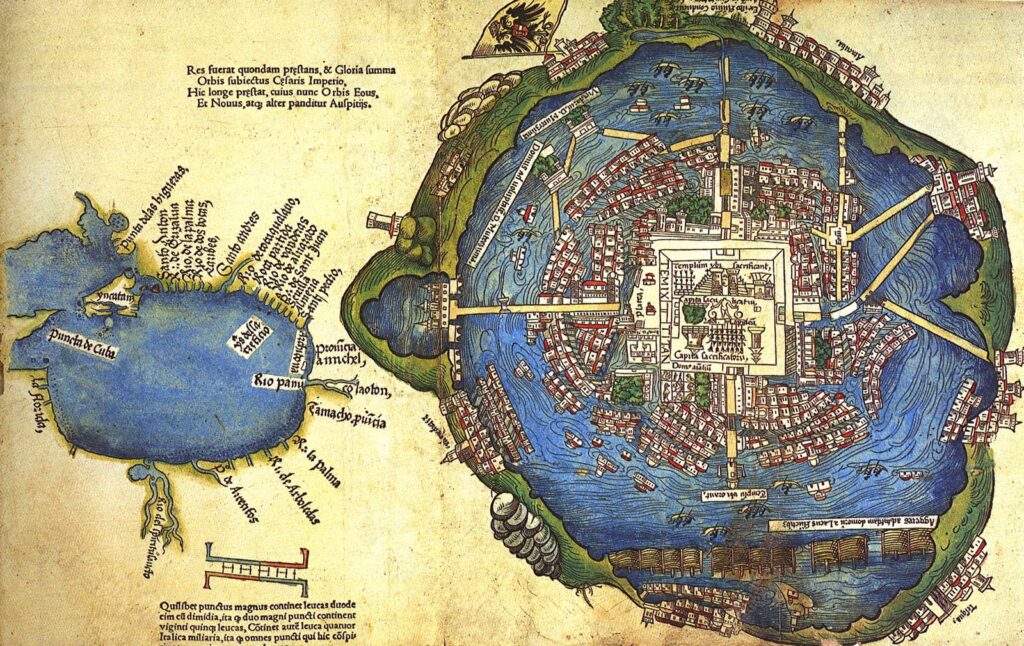
On 30 October 1520, Cortés completed his Second Letter to Charles V.
This was written before the final fall of Tenochtitlan. Cortés and his forces had already entered the city, taken Moctezuma into Spanish custody, been driven out during the catastrophic retreat of June–July 1520, and reached the comparative safety of Tlaxcala.
The letter therefore does not describe an inevitable victory.
It describes a campaign whose outcome remained uncertain.
The Library of Congress notes that Cortés’s letters presented both himself and his actions favourably. His Second Letter recounts his alliance with the Tlaxcalans, contacts with Moctezuma’s representatives, his entry into Tenochtitlan and the retreat later remembered by the Spanish as the Noche Triste.
That makes the document enormously valuable.
It also makes it interested testimony.
Cortés was not writing privately for posterity. He was writing to his sovereign while attempting to justify extraordinary actions and preserve his political position.
His account cannot simply be discarded because of that.
Nor should it simply be accepted.
The correct question is:
What does Cortés admit even when describing the campaign in terms favourable to himself?
One answer is striking.
He admits the alliances.
The people Cortés could not conquer without
Tlaxcala was not part of the Mexica-controlled imperial system centred upon Tenochtitlan.
Its people initially fought the Spaniards.
Then they changed strategy.
The subsequent alliance fundamentally altered Cortés’s position. Tlaxcala provided experienced warriors, supplies and a secure political and military base from which the Spaniards could recover after their expulsion from Tenochtitlan.
The scale matters.
Research on the 1521 siege estimates that approximately 1,000 Spaniards represented only a small part of the attacking coalition, beside tens of thousands of Tlaxcalan and other Indigenous combatants.
David Carballo similarly describes Cortés as joining forces with tens of thousands of Mesoamerican allies rather than destroying the Mexica state through Spanish manpower alone.
These were not merely porters following a European army.
They were armies.
Nor were they politically passive.
Different Mesoamerican states had grievances, rivalries, strategic interests and territorial ambitions that pre-dated the arrival of the Spaniards. Modern scholarship stresses that Indigenous participation has to be understood within those existing political relationships rather than simply as submission to European direction.
That changes the shape of the conquest.
Cortés did not arrive in an undivided political world.
He entered one already divided.
And he survived because some of those divisions became alliances.
The problem with the word “Aztec”
There is a terminology problem worth clearing away.
“Aztec Empire” remains useful shorthand, but it can obscure the political structure Cortés encountered.
The central imperial power was the Triple Alliance, dominated by the Mexica of Tenochtitlan alongside Texcoco and Tlacopan. Its authority operated through warfare, tribute, political relationships and subordinate communities rather than through anything resembling a modern territorial state.
That matters because opposition to Tenochtitlan did not require people to understand themselves as joining foreigners against their own “country.”
There was no Mexican nation being betrayed.
There were competing altepetl — Indigenous political communities — making calculations about enemies, allies, tribute and survival.
They could not know what Spanish colonial rule would later become.
A useful warning from recent scholarship is that participants in 1519–21 did not possess our knowledge of what followed. Indigenous allies were making decisions inside their own political present, not consciously choosing the creation of three centuries of Spanish colonial government.
History often makes choices look obvious only after their consequences are known.
Exhibit Two: the Indigenous record
If Cortés were our only witness, the story would already be incomplete.
He is not.
One of the most extraordinary sources for the conquest is Book XII of the Florentine Codex, assembled under the Franciscan Bernardino de Sahagún later in the sixteenth century.
Its importance lies partly in whose memories it attempted to preserve.
The Library of Congress describes Book XII as an account built from testimony by Indigenous elders who had lived through the conquest. Sahagún gathered these accounts around 1553–55, several decades after the events but while people who had experienced them were still alive.
Sahagún himself explained why another account mattered.
Spanish writers had already recorded what the conquerors knew.
The conquered, he observed, knew things that the conquerors did not.
That is an extraordinarily important historical principle.
The same event can produce separate archives.
The victor knows one part.
The defeated know another.
Neither perspective automatically becomes the whole truth.
Tenochtitlan was not awaiting inevitable defeat
Later history makes the result deceptively tidy.
Cortés arrived.
Cortés marched inland.
Cortés entered Tenochtitlan.
Tenochtitlan fell.
But between the third and fourth of those statements lies nearly two years of uncertainty.
The Spaniards were almost destroyed.
Their position inside Tenochtitlan became untenable in 1520. Their retreat cost them heavily. Cortés was forced back into Tlaxcalan territory and remained dependent upon Indigenous support while rebuilding his force.
The Mexica therefore did something that simplified versions of the conquest can obscure.
They defeated Cortés and drove him from their capital.
The Spaniards returned because the political and military coalition around them survived.
That distinction is enormous.
Exhibit Three: Malintzin
There is another person whose presence exposes the inadequacy of the solitary-conqueror story.
Malintzin — also called Doña Marina and later La Malinche — was an Indigenous woman who became Cortés’s principal interpreter.
Initially communication could operate through a remarkable chain.
A Nahuatl speaker spoke to Malintzin.
She translated Nahuatl into Maya.
Gerónimo de Aguilar translated Maya into Spanish for Cortés.
Cortés replied in Spanish.
The sequence then moved backwards.
The implications go beyond language.
Before Cortés could exploit political divisions, he had to understand them.
Before he could make agreements, he had to communicate.
Before he could issue threats, receive warnings, question emissaries or negotiate with leaders, somebody had to move meaning between worlds.
That was power.
And Indigenous sources noticed it.
A study in The Historical Journal examines Malintzin’s representation in the Lienzo de Tlaxcala and argues that its Tlaxcalan authors presented her not simply as a passive translator but as a conspicuous and powerful participant in conquest.
In some later European storytelling she becomes an accessory to Cortés.
The Indigenous visual record puts her back into the scene.
Exhibit Four: the Lienzo de Tlaxcala
Perhaps the most direct challenge to the traditional Cortés-centred narrative comes from Tlaxcala itself.
Around the middle of the sixteenth century, Tlaxcalans created what is known as the Lienzo de Tlaxcala.
The original cloth has been lost, but its imagery survives through later copies and reconstructions.
Its story is unmistakable.
This was not a people depicting themselves as anonymous assistants to Spanish heroes.
They were documenting their conquest.
Art historian Byron Ellsworth Hamann describes the original as a huge painted cloth containing dozens of scenes depicting the overthrow of the Mexica state by a joint Indigenous-European force.
Federico Navarrete places the Lienzo within a much larger body of Indigenous histories and legal testimony produced by Mesoamerican conquerors seeking recognition, privileges and rewards from the Spanish Crown.
Indigenous groups were therefore not merely present in the conquest.
They later entered the archive to claim ownership of their contribution to it.
That may be the most important piece of evidence in the entire question.
Cortés told Charles V:
Look what I have done for you.
Tlaxcala effectively answered:
Look what we did.
The battle after the battle
This is why conquest history did not end in 1521.
Once the military struggle finished, another contest began.
Who deserved privileges?
Who had rendered service?
Who had fought whom?
Who had remained loyal?
Which communities deserved exemptions?
Who could prove what they had done?
The answer increasingly depended upon documents.
Histories became petitions.
Images became evidence.
Memories became claims.
The archive became part of the political settlement created by conquest.
Disease enters the war
Politics and manpower alone still do not explain the outcome.
In 1520, smallpox spread through central Mexico.
The consequences were catastrophic.
The disease affected populations without previous exposure and struck during the period between Cortés’s expulsion and the renewed assault on the capital. Modern scholarship treats the epidemic as an important component of the collapse, alongside Indigenous alliances and Spanish military technologies.
It is tempting to transform this into another simple equation:
Spaniards + smallpox = victory.
The evidence again resists simplicity.
Disease did not negotiate alliances.
It did not construct ships.
It did not carry supplies.
It did not decide which Indigenous communities would fight Tenochtitlan.
It did, however, catastrophically alter the human circumstances in which those political and military decisions were being made.
The conquest was not caused by one thing.
It was a convergence.
Thirteen ships — and who built them?
Even one of the most famous examples of Spanish technological advantage becomes more complicated under scrutiny.
For the final siege, Cortés ordered the construction of thirteen brigantines to contest control of Lake Texcoco.
European ship technology mattered.
But scholarship has examined the enormous Indigenous labour contribution behind the vessels and the canal infrastructure needed to deploy them.
Research published by Cambridge University Press describes the project explicitly as one undertaken by Spanish conquistadors and their Native allies — from the gathering and preparation of timber through transportation, assembly and canal construction.
Even the Spanish fleet was therefore not entirely a Spanish achievement.
The technology may have crossed the Atlantic.
Much of the labour did not.
So who conquered Tenochtitlan?
There is no credible evidence-based version in which Cortés disappears.
He mattered enormously.
He held together a Spanish expedition after breaking with Diego Velázquez.
He recognised political divisions and exploited them.
He negotiated alliances.
He survived military disaster.
He coordinated a renewed assault.
He possessed military technology that could produce disproportionate effects.
And after victory, Spaniards ultimately seized the political settlement.
But there is equally no credible evidence-based version in which Cortés and several hundred Europeans conquered central Mexico by themselves.
They did not.
The surviving record points instead to a coalition war involving Spaniards and large Indigenous forces operating for different reasons against the Mexica state.
Ross Hassig has pushed that interpretation very far, arguing that Indigenous political circumstances were so important that the conquest can initially be understood as an Indigenous victory over other Indigenous peoples, with Spaniards subsequently manipulating the settlement to secure the longer-term political victory. That is an interpretation rather than an uncontested fact, but it demonstrates how far scholarship has moved from the old “few hundred Spaniards defeat an empire” model.
The distinction between winning the war and winning what came after it may be the key.
Tlaxcalans could help defeat Tenochtitlan.
That did not mean Tlaxcalans would control New Spain.
The verdict the evidence allows
The old story is too simple.
The opposite story — in which Cortés becomes almost irrelevant — would be too simple as well.
The evidence supports something more difficult.
Tenochtitlan fell to a coalition containing a relatively small Spanish military force and very large numbers of Indigenous allies, particularly Tlaxcalans, operating amid pre-existing political rivalries and transformed by epidemic disease. Translators including Malintzin made diplomacy possible. Indigenous labour supplied and constructed much of the campaign’s infrastructure. Spanish weapons, horses, ships and military practices added capabilities the coalition could exploit.
Then the balance changed.
Spanish victory in the political settlement gradually overshadowed Indigenous participation in the memory of the military victory.
Cortés became the name.
The coalition became supporting cast.
Fortunately, Cortés did not control the entire archive.
The Florentine Codex survives.
Indigenous pictorial histories survive.
Tlaxcalan claims survive.
And when those records are put beside the conqueror’s letters, the picture changes.
Not because Cortés vanishes.
Because thousands of other people return.
Evidence note
The term “conquest of Mexico” is retained here because it is the conventional name for the events, but it should not imply that a modern Mexican nation existed in 1519 or that one unified Indigenous population confronted Spain. The principal war examined here was the conflict culminating in the fall of Mexico-Tenochtitlan in 1521. Recent scholarship increasingly uses formulations such as the Spanish-Aztec War precisely to expose some of the assumptions built into the older terminology.
Principal evidence and further reading
- Library of Congress — Cortés, Second Letter of Relation
- Library of Congress — Florentine Codex, Book XII
- Digital Florentine Codex — Book XII
- Oxford Academic — Indigenous conquistadors and conquest histories
- The Historical Journal — Malintzin in the Lienzo de Tlaxcala
- The Americas — Native ship and canal building during the Spanish-Aztec War
- Colonial Latin American Review — Indigenous participation in the conquest
Featured image: Map of Tenochtitlan and the Gulf of Mexico, published at Nuremberg in 1524 with the Latin edition of Cortés’s Second Letter. Original in the Newberry Library; public-domain reproduction via the World Digital Library/Wikimedia Commons. The Library of Congress describes this printing as containing the first published European plan of Tenochtitlan.