TBA-017 · Public Evidence Audit
The Bonfires of Paperwork
St Albans, Cambridge, Bury St Edmunds, the Savoy · June 1381
Across England in June 1381, rebels did not only burn buildings and kill officials. At multiple sites they broke open muniment chests and set manorial rolls, charters and registers alight. Popular retelling treats this as incidental vandalism alongside the violence. The record supports a more specific claim, and a more limited one: that burning documents was a deliberate strategy, and that it did not achieve what it aimed at.
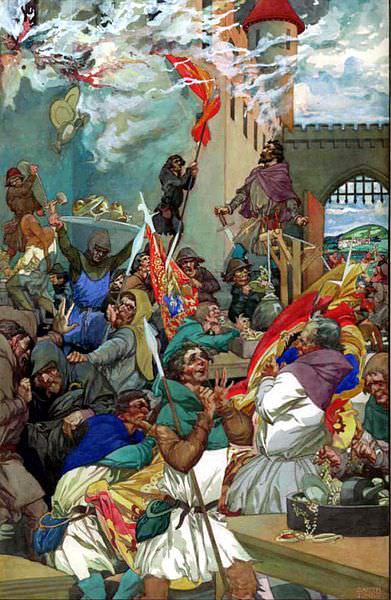
“The Peasants burn Palace of the Savoy,” Alfred Garth Jones (1872–1955) — a later artistic imagining, not a contemporary depiction.
Claim tested
Did burning manorial rolls and charters in June 1381 actually free the rebels who destroyed them from villeinage and its obligations?
Concise verdict
No, not in law. Record-burning at St Albans, Cambridge and elsewhere was a coordinated, repeated tactic aimed at the documents that recorded villein status, rents and services — what the historian Steven Justice calls “the skeleton of lordship.” But duplicate records survived in monastic cartularies, royal charters of manumission extracted under duress were revoked within weeks, and manorial rolls were being reconstructed by landlords within two years. The claim tested is best classified as supported as strategy and symbolism, unsupported as legal effect.
Why this claim matters
The 1381 revolt is usually remembered through set-piece moments — John Ball’s sermon, Wat Tyler’s death at Smithfield, the boy king Richard II riding out to meet the rebels. The systematic targeting of documents is less often foregrounded, yet it shows a level of strategic understanding that is easy to miss if the revolt is read only as spontaneous violence. Testing the claim precisely — strategy versus legal effect — avoids two opposite errors: dismissing the record-burning as mindless destruction, and overstating it as an act that succeeded in abolishing servitude outright.
Chronology
13 JUNE 1381
Rebels storm the Savoy Palace, London residence of John of Gaunt, Duke of Lancaster. Alongside the plunder later documented in the King’s Bench record, Gaunt’s household books and papers are destroyed. This was not a formal library in the modern sense, but its destruction was read as a direct strike at the kingdom’s most resented magnate.
MID-JUNE 1381
William Grindecobbe, returning from London, leads townspeople in storming St Albans Abbey’s storerooms. Rolls and charters are dragged into the marketplace and burned. Among the rebels’ specific demands is production of an ancient town charter, believed to date to the reign of King Offa of Mercia in 793 — a document the townspeople insisted the abbey possessed and was concealing. Abbot Thomas de la Mare is compelled to issue a new charter surrendering privileges.
MID-JUNE 1381
In Cambridge, townspeople throw university registers into a bonfire. The chronicler Thomas Walsingham records them dancing round the flames and shouting “Away with the learning of clerks, away with it!” — a phrase now well enough attested that it carries its own entry in modern reference works.
15 JUNE 1381
At Bury St Edmunds, rebels led by John Wrawe besiege the abbey and kill Sir John Cavendish, Chief Justice of the King’s Bench and a principal author of the poll tax, along with Prior John de Cambridge. Both men are beheaded, their heads mounted on spikes in the marketplace facing one another. Contemporary accounts foreground the killings; whether abbey muniments were also burned in 1381, as they had been targeted in an earlier 1327 riot at the same abbey, is not established with the same clarity.
1381–1383, AFTERMATH
Royal charters of manumission and pardon, granted under duress during the revolt, are formally revoked by the Crown within weeks. The revolt itself collapses within a month. Landlords across the affected counties move to re-establish their documentary basis for rents and services; historians of the manorial record note rolls being recompiled within roughly two years of the burnings.
Source hierarchy
Thomas Walsingham’s chronicle is treated as a near-contemporary narrative source, hostile to the rebels and writing as a monk of St Albans with a direct institutional stake in the events he describes — his account of the record-burnings is corroborated independently at multiple sites, which strengthens it, but his framing of rebel motive should be read with that bias in view. Steven Justice’s Writing and Rebellion: England in 1381 (University of California Press) is treated as the governing modern academic synthesis for the interpretive claim that document destruction was strategic rather than incidental. The Grindecobbe and Bury St Edmunds chronology is cross-checked against independent modern summaries rather than a single source.
Provenance assessment
This audit relies on published chronicle translations and modern secondary synthesis rather than direct inspection of manuscript sources (Walsingham’s Latin chronicles, the St Albans and Bury St Edmunds abbey registers). The specific claim that Essex manorial rentals were recompiled by 1383 rests on general historical consensus about post-revolt record reconstruction rather than a single named estate record independently verified for this audit, and is flagged accordingly below.
Contradiction table
A dossier does not smooth over conflicts in the record. Where sources disagree, or where evidence is thinner at one site than another, the difference is stated rather than resolved by preference for the more dramatic version.
| Point of fact | Popular retelling | What the record supports | Status |
|---|---|---|---|
| Legal effect of burning the rolls | Often implied that destroying the rolls freed villeins from bondage | Manumissions granted under duress were revoked; rolls were reconstructed; lordship reasserted itself within roughly two years | Contradicted |
| Whether record-burning was strategic or incidental | Often folded into general scenes of riot and looting | Repeated, targeted at specific document types (rolls, charters, registers), across independent sites | Supported |
| Bury St Edmunds record destruction | Sometimes grouped with St Albans and Cambridge as a third clear record-burning site | Contemporary accounts emphasise the killings of Cavendish and de Cambridge; systematic 1381 record destruction is not established with the same clarity as at St Albans and Cambridge | Unconfirmed |
Evidential classification
| Claim | Classification |
|---|---|
| Rebels burned rolls and charters at St Albans and university registers at Cambridge in June 1381 | Supported (Walsingham, corroborated by independent modern summaries) |
| Gaunt’s household books and papers were destroyed at the Savoy on 13 June 1381 | Supported |
| Burning the rolls legally abolished villeinage for those who destroyed them | Unsupported (manumissions revoked; rolls reconstructed; lordship reasserted) |
| Record destruction at Bury St Edmunds was as systematic as at St Albans and Cambridge | Unresolved (sources emphasise the killings; document destruction not clearly attested for 1381 specifically) |
What can safely be said
“In June 1381, rebels at St Albans, Cambridge and the Savoy Palace deliberately destroyed manorial rolls, charters and household records — a repeated, targeted tactic aimed at the documents underpinning lordship, not incidental damage during general rioting. The tactic did not achieve lasting legal effect: manumissions extracted under duress were revoked, and landlords rebuilt their documentary basis for rents and services within a few years.” This is directly supportable from Walsingham’s chronicle, corroborated across independent sites, and from the well-documented collapse of the revolt’s legal gains.
Unresolved evidence gaps
Walsingham’s chronicle has not been independently checked against the Latin manuscript for this audit; the finding rests on published translations and secondary synthesis. Whether Bury St Edmunds saw systematic record destruction in 1381 itself, as opposed to the better-attested 1327 precedent, remains unresolved. The specific claim that Essex manorial rentals were recompiled “by 1383” has not been traced to a single named estate record for this audit and should be treated as representative of the general pattern rather than a verified individual case.
Source schedule
| Source | Type |
|---|---|
| Thomas Walsingham, chronicle accounts of St Albans and Cambridge | Near-contemporary narrative, published translation |
| Steven Justice, Writing and Rebellion: England in 1381 (University of California Press) | Modern academic synthesis |
| Abbey of St Edmund Heritage Partnership, on Cavendish and de Cambridge deaths at Bury St Edmunds | Institutional secondary account |
| CDAMM, on William Grindecobbe and the St Albans uprising | Modern secondary summary |
Related reading
For the Savoy burning itself, and the woman a King’s Bench jury named as its chief leader, see The Woman Accused of Burning the Savoy on The Monument Room. For the Tower assault that followed the next day, see TBA-011: The Tower, 1381.
Commission work using this method.
Private dossiers apply the same source hierarchy, provenance assessment, contradiction mapping and evidential classification to your subject — scoped to your specific claim, intended use and deadline.