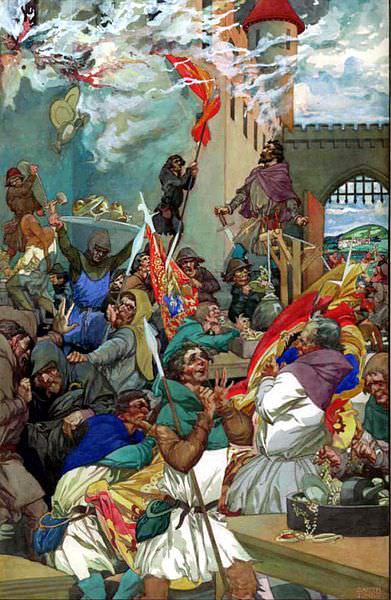
Image above: “The Peasants (Wat Tyler) burn Palace of the Savoy,” Alfred Garth Jones (1872–1955). A later artistic imagining, not a contemporary depiction, and its own title misattributes the burning to Wat Tyler rather than the leader named in the indictment below.
On 13 June 1381, a jury later swore, Joanna Ferrour of Rochester walked into the Savoy Palace as “chief perpetrator and leader” of a mob that burned it to the ground. The record of what happened next survives. So does a question nobody has ever answered.
Read the full public evidence audit of this day’s events: TBA-011: The Tower, 1381, and, on the record-burning tactic itself, TBA-017: The Bonfires of Paperwork.
On the Thursday before the feast of Corpus Christi, in the fourth year of the reign of Richard II, a woman from Rochester crossed the Thames into Middlesex at the head of a crowd.
We know this not from a chronicler’s flourish but from a jury. Sworn before the king at Westminster, they presented that Joanna, wife of John Ferrour of Rochester in the county of Kent, came as the chief perpetrator and leader of a great society of rebellious wrongdoers from Kent, and, as an enemy of the king, burned the said manor: the Savoy Palace, London residence of John of Gaunt, Duke of Lancaster, the most powerful and most hated man in England.
She did not stop at arson. The indictment states that she seized a chest containing £1,000 and more belonging to the duke, had it carried down to a boat on the Thames, and took it all the way to Southwark, where she divided the gold between herself and others.
The following day, Friday 14 June, the same jury says she did it again: leading the burning of the Hospital of St John at Clerkenwell, and carrying off two horses loaded with stolen wool. And then, the record states, in the same breath: the same Joanna, together with others, went as chief leader to the Tower of London, and laid violent hands first on Simon, lately Archbishop of Canterbury, and then on Brother Robert Hales, lately Prior of St John, and she dragged them out of the Tower and ordered that they be beheaded.
That is the indictment. It survives today at the National Archives, catalogued as KB 27/482, membrane rex 39d. A photograph of the actual parchment (brown ink, tight secretary hand, six and a half centuries old) is what a leader looked like to the men who wrote the record.
Evidence tier: PROVEN. The surviving indictment records that a jury accused Joanna Ferrour, by name, of these acts. That the accusation exists, in these words, is proven. Whether the acts themselves happened exactly as charged is a separate question, one the trial itself went on to test.
Inside the Tower
To understand what she is accused of walking into, it helps to know who was already there.
The chronicler Henry Knighton, writing decades later but drawing (in R.B. Dobson’s judgement) on genuinely well-informed sources close to the Lancastrian household, describes the scene inside the Tower on the eve of the attack: about 150 knights (some said 180), the king’s mother, the Duchess of Brittany, “and many other ladies.” Also sheltering there: Archbishop Sudbury; Robert Hales, prior of the Hospital and royal Treasurer; and, Knighton notes almost in passing, “Henry, earl of Derby, son of John, duke of Lancaster, although still a young boy.”
That boy was the future Henry IV. Dobson’s own footnote to this passage gives his birth year as 1366, which would make him fifteen that June, though his exact birthdate was never recorded, and modern biographers still disagree on the year.
Knighton describes the mood inside as something close to paralysis. When the king rode out to meet the commons at Mile End, the knights who were meant to accompany him, he writes, “completely lost their courage and no spirit whatsoever; they seemed to be struck by womanly fears, and dared not leave but stayed within the Tower.” It is not a flattering picture. Dobson’s own editorial assessment of Knighton’s account of these London events, taken as a whole, is that it “carries conviction” and, thanks to Knighton’s Lancastrian connections, has “particular authority” on the Savoy in particular, even while noting that Knighton confused the chronology of the day and mistakenly conflated Wat Tyler with Jack Straw elsewhere in the same narrative.
The king left. The mob got in anyway.
Evidence tier: PROBABLE, at chronicle level. This is Knighton’s account, not an independent administrative record, and Knighton is not a flawless witness. But it is a near-contemporary, internally consistent description written by someone with plausible access to Lancastrian sources, and nothing in the surviving record contradicts it.
The Trial
Joanna did not stay free for long. The sheriff of London was ordered to arrest her; she was brought before the King’s Bench, committed to the Marshalsea prison, and asked how she wished to answer the charges. She said she was not guilty, and put herself on the country. In other words, she asked to be judged by a jury.
The jury came back with a divided verdict. On the Savoy charge and the Clerkenwell charge, she was acquitted. On the third and most serious charge, the killing at the Tower, the jury did not rule at all. André Réville’s 1898 edition of the case, read directly for this piece, explains why: the Tower stood within the city of London, not the county of Middlesex, and the Middlesex jurors had no authority to judge anything that happened there. That reasoning is Réville’s account of the proceedings, not a quotation from the record itself, which states only the outcome. Joanna was released on bail instead, ordered to return to court once the judges had more information. No later record of that return has been found.
She was released on the surety of four men: William Pren, parson of Wormstone; Walter Halle; John Base; John Lowet. Whatever they knew or believed about her, they were willing to stake their own liability on her good behaviour.
Evidence tier: PROVEN. The verdict, the mainpernors, and their names all survive in the same membrane as the original charge. That the Tower charge specifically was reserved, not resolved, is established by direct inspection of Réville’s printed edition of the case.
Was the indictment true? Historians have disagreed since the record was first published by the French scholar André Réville in 1898. R.B. Dobson, working from Réville’s edition seventy years later, wrote of a related Rochester indictment that “the indictments may have been malicious or mistaken.” Juries in the aftermath of 1381 were not above settling old scores under cover of the general chaos, and an accusation naming a woman as the leader of an attack on a royal duke’s own palace, rather than a subordinate participant, is unusual enough to raise an eyebrow on its own. Acquittal, on the two charges the Middlesex jury actually ruled on, could mean she didn’t do it. It could also mean four Kentish men were willing to vouch for a neighbour the jury system had, for whatever reason, decided to make an example of.
The record does not resolve this, and neither will we. What can be said plainly: an English jury, within two years of the revolt, formally cleared her of two of the three charges against her. The third, the killing at the Tower, was left open, not resolved in her favour.
A Second Indictment, and a Husband
Joanna was not the only member of her household named in the King’s Bench rolls. Réville’s edition, read directly for this correction, shows two further entries, entirely separate from hers: one for her husband, John Ferrour, and one for a third man, Roger atte Wode of Kent, each accused of the same conduct.
An earlier version of this piece described these as a single joint indictment, naming John, Joanna, Roger atte Wode, and a fourth man, David Calvelei, together as joint “principal actors and leaders.” That is not what the surviving document shows, and it has been corrected here. Réville’s Appendice II presents three separate King’s Bench entries, one for each defendant, not a combined indictment naming all of them at once. The only “David Calvyle” appearing in Réville’s index is a cleric named in an unrelated dispute over a church prebend at Salisbury. He has no documented connection to this case, and the claim linking him to it has been withdrawn.
John’s case took its own path. A Middlesex jury acquitted him on 2 November 1383, more than two years after his arrest. Acquittal did not end the matter: Parliament had excluded him by name from the general amnesty offered after the revolt, and the court held him until William Walworth, the former mayor of London, confirmed on 11 November 1383 that no separate summons in London concerned him. Roger atte Wode’s case ended differently again. Summoned repeatedly and failing to appear, he was outlawed, then pardoned when he presented himself to the king on 21 January 1383. His case never reached a jury verdict on the substance of the accusation at all. Neither his case nor John’s resolves what happened to the still-open Tower charge against Joanna.
The citation discrepancy this piece previously flagged as unresolved is now settled. Réville’s edition places Joanna’s case in document 13 of his appendix, John’s in document 14, and Roger’s in document 15, corresponding respectively to the KB 27/482 and KB 27/485 regions identified in Sylvia Federico’s 2001 study of women’s roles in the 1381 rolls. These are three separate documents, not variant citations for a single one.
Evidence tier: PROVEN, from direct inspection of Réville’s printed edition, that three separate King’s Bench entries exist for Joanna, John, and Roger, with three separate outcomes: a partial acquittal with an unresolved remainder for Joanna; a full acquittal followed by continued detention on an unrelated question for John; an outlawry followed by pardon, without any verdict, for Roger. The earlier claim that the three were named together in a single joint indictment with a fourth man is CONTRADICTED by that same edition and has been removed.
The Boy in the Tower, Nineteen Years Later
Here the record does something almost unbearably suggestive, and almost nothing more.
In January 1400, a man named John Ferrour of Southwark was pardoned for his part in a rebellion against the newly crowned King Henry IV, the same boy, grown into a king, who had sheltered in the Tower that June day in 1381. The pardon states plainly why it was granted: because Ferrour had saved Henry’s life “in a wonderful and kind manner” during the attack on the Tower, nineteen years before, on 14 June 1381.
Ferrour was, as the historian Juliet Barker notes in England, Arise (2014), a common enough name in fourteenth-century England that this alone proves nothing. But the coincidences accumulate: a Southwark connection, the very place Joanna and John Ferrour of Rochester carried Gaunt’s stolen gold. A documented use of the alias “John Marchall” for the Rochester Ferrour, confirmed independently in a 1386 property deed in the Calendar of Close Rolls, one that names both of them together: “John Marchall otherwise Ferrour of Rouchestre and Joan his wife,” jointly granting a tenement in Southwark, in the parish of St George, alongside houses in Rochester. Whatever the Southwark connection amounts to, by 1386 it was a shared holding of the couple, not a property of John’s alone. And the timing: according to Barker’s account, John Ferrour of Rochester was excluded from the general amnesty because of the Sudbury-Hales charge specifically, and was only finally cleared in November 1383, some two and a half years after his arrest, when William Walworth confirmed he had no case to answer. That is an unusually long delay for a man already acquitted by a jury on every other count.
Barker puts it as a question, not a claim: if the two men are one and the same, then the boy some accounts say he helped drag an archbishop out to die grew up to pardon the very man responsible for it.
Evidence tier: POSSIBLE. No document yet found states outright that the John Ferrour who stormed the Tower and the John Ferrour who saved Prince Henry inside it are the same person. It is not proven. It may never be. But it is not nothing, either. The honest answer, on the evidence as it stands, is that we do not know.
What the Record Won’t Say
There is a temptation, writing about 1381, to resolve every gap with the most satisfying story. It would make a better tale if the man who burned down a duke’s palace turned out to be the same man who, on the very same day, saved that duke’s son’s life: treason and grace bound up in one household.
The record does not currently permit that conclusion. It permits the question.
What it does permit, without qualification, is this: a woman from Rochester was formally accused, by a sworn jury, of leading men who burned a royal palace, stole a fortune, and dragged an archbishop to his death. A jury cleared her of the first two of those charges. The third, the most serious, was never resolved in her favour or against her, in any record found so far. She was bailed, not exonerated, and what became of that open charge is the one question this piece cannot answer.
Sources: TNA KB 27/482 rex m. 39d; TNA KB 27/485 rex m. 30d; The People of 1381 database, www.1381.online (participant records for Joanna Ferrour and John Ferrour of Rochester); Calendar of Close Rolls 1385–9, pp. 248–9; Henry Knighton, Chronicon, trans. in R.B. Dobson, The Peasants’ Revolt of 1381 (Macmillan, 1970), document 27, p. 182; Juliet Barker, England, Arise: The People, the King and the Great Revolt of 1381 (Little, Brown, 2014); Sylvia Federico, “The Imaginary Society: Women in 1381,” Journal of British Studies 40, no. 2 (2001), pp. 159–183 (cited for the KB reference identifications; not read directly by this project); A. Réville, Le Soulèvement des Travailleurs d’Angleterre en 1381 (Paris, 1898), Appendice II, Série A, documents 13–15, pp. 199–203, read directly from a digitized scan of the printed edition for this correction.
Correction note (2026-09-11): this piece originally reported that the Middlesex jury acquitted Joanna Ferrour outright, and that a single joint indictment named her, her husband, and two other men together. Direct inspection of Réville’s 1898 edition shows the acquittal was partial (the Tower charge was reserved, not resolved) and that the three men’s cases are separate King’s Bench entries. Both claims have been corrected above.
Featured image: “The Peasants burn Palace of the Savoy during the Peasants’ Revolt,” Alfred Garth Jones (1872–1955), public domain.